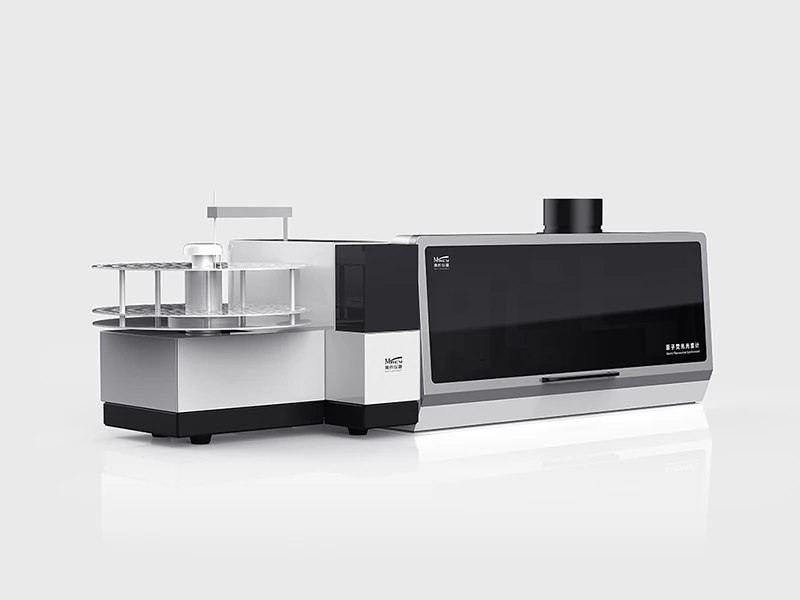
The Macylab AFS-6801 is an Atomic Fluorescence Emission Spectrometer designed for the high-sensitivity measurement of trace and ultra-trace elements, specifically those capable of hydride generation. Featuring a dual-channel design, it can measure two elements simultaneously without channel interference, even when there is a significant concentration difference between the elements in the sample.
Built with a short focal length, non-dispersive closed optical system, the instrument incorporates a translucent, corrosion-resistant ABS magnetic front door that isolates the measurement environment from external air. It is widely utilized for determining 12 specific elements, including Arsenic (As), Mercury (Hg), and Selenium (Se), across environmental, food, and geological testing applications.
Key Features
Dual-Channel Simultaneous Measurement: Incorporates a signal splitting control module that allows two channels and two elements to be measured at the same time, supporting testing departments that handle large sample volumes.
High-Efficiency Gas-Liquid Separation: Utilizes a gusher flow two-stage chemical gas-liquid reaction separation device. This ensures complete chemical reactions and effective separation, particularly useful for complex samples like rock, ore, and soil.
Automated Sample Injection: Employs a continuous flow injection method driven by a 6-channel peristaltic pump with adjustable software speed regulation. This improves efficiency, allowing a sample to be tested three times in 30 seconds.
Intelligent Light Source Management: Uses coded hollow cathode lamps driven by a pulse modulation/constant current power supply. The instrument automatically identifies the lamp, monitoring its working state and service life.
Argon Gas Control & Waste Removal: Features a specific gas circuit design that allows for the shutdown of the gas source at any time to conserve Argon gas consumption. Waste liquid is removed using a pressure self-balancing function, eliminating the need for an additional discharge pump.
Background & Interference Reduction: Reduces the excitation angle of the light source and photomultiplier tube (PMT) to increase the received fluorescence signal while lowering background interference.
Specifications
Parameter
Specification
Model
AFS-6801
Optical Design
Short focal length, non-dispersive, integrated closed optical design
Measurement Channels
Dual-channel (simultaneous measurement of two elements)
The AFS-6801 is utilized for trace and ultra-trace analysis of 12 specific elements (As, Hg, Se, Sn, Pb, Bi, Sb, Te, Ge, Cd, Zn, Au) in diverse sample types:
Geological and Mining Testing: Determination of trace elements in complex matrices such as rock, ore, and soil extracts, supported by the two-stage gas-liquid separation device.
Environmental Monitoring: Analyzing water quality and environmental samples for heavy metal contaminants like Mercury, Arsenic, and Lead.
Food Safety: Routine detection of toxic trace elements in agricultural and food products.
Clinical and Biological Research: Measuring specific hydride-forming trace elements in biological matrices.
Who is it for?
High-Throughput Testing Departments: Laboratories processing a large quantity of samples daily, benefiting from the instrument’s ability to measure two channels simultaneously and perform rapid injection tests.
Geological and Environmental Labs: Analytical facilities that encounter complex sample matrices with numerous potential interfering elements.
Quality Control Institutions: QC departments in agriculture and food processing requiring reliable data and clear compliance with product safety certifications.
Why choose it?
Efficiency in Sample Processing: The continuous flow injection method using the peristaltic pump allows for a streamlined testing procedure, completing three consecutive measurements of a single sample in just 30 seconds.
Matrix Interference Management: The instrument maintains stable readings even in complex samples. Elements like Fe, Al, Mg, Ca, K, Na, and Cu do not interfere with measurements. For precious metals (Au, Ag, Pt, Pd) that may cause interference, adding thiourea or an iron salt can mitigate the effect.
Certified Safety and Reliability: The instrument’s circuit separates strong and weak currents for operational stability. It complies with major international product qualifications, holding certifications including the European CE mark, North American ETL, FCC, RoHS, China CQC, and 3C.
Packaging, Installation & Operation
Packaging & Shipping
After unpacking the instrument, compare the contents with the packing list and check that all items are present and undamaged.
Installation & Setup
Place the spectrophotometer in a suitable location away from direct sunlight, dust, corrosive gases, and strong vibrations. For stable operation, keep it away from strong magnetic or electrical fields and electrical devices that may generate high-frequency fields.
Keep the area around and underneath the instrument clear to allow adequate airflow.
Use the appropriate power cord and connect the instrument to a grounded outlet.
Initial Operation
Turn on the spectrophotometer and allow it to warm up for the recommended time before taking measurements. Follow the instrument’s operating instructions to complete any required system initialization, calibration, or wavelength verification before measurement.
Exhibition
FAQ (Frequently Asked Questions)
The instrument is designed for the trace analysis of 12 elements: Arsenic (As), Mercury (Hg), Selenium (Se), Tin (Sn), Lead (Pb), Bismuth (Bi), Antimony (Sb), Tellurium (Te), Germanium (Ge), Cadmium (Cd), Zinc (Zn), and Gold (Au).
Yes, the AFS-6801 features a dual-channel design with a lane-splitting signal control module. This allows two elements to be measured simultaneously without channel interference, even if their sample concentrations differ significantly.
No. The exhaust system features a pressure self-balancing liquid waste removal function, which discharges waste liquid without requiring an additional dedicated pump.
The carrier gas flow stabilizing device eliminates bubbles generated by potassium borohydride online. It also reduces the diffusion effect between reagents, supporting measurement stability.
Yes. The instrument is equipped with an external filter argon-hydrogen flame real-time observation window, allowing operators to directly observe the flame state during the test process.