
Principle
After the sample was digested, it was injected into the atomic absorption spectrometer. After flame atomization, potassium and sodium absorbed 766.5 nm and 589.0 nm resonance lines respectively. Within a certain concentration range, the absorption value was proportional to the content of potassium and sodium, and the quantitative comparison was made with the standard series.
Reagents and materials
All reagents used are of superior purity, and water is the second grade water specified in GB/T 6682.
Nitric acid (HNO3).
High chloric acid (HCIO4).
Cesium chloride (CsCl).
Potassium chloride standard (KCI): purity greater than 99.99%.
Sodium chloride standard (NaCl): purity greater than 99.99%.
Nitric acid (HNO3).
High chloric acid (HCIO4).
Cesium chloride (CsCl).
Potassium chloride standard (KCI): purity greater than 99.99%.
Sodium chloride standard (NaCl): purity greater than 99.99%.
Standard solution preparation
Potassium and sodium standard stock solution (1000 mg/L): Potassium chloride or sodium chloride was dried in an oven at 110 C~120 C for 2h.We accurately weighed 1.9068g potassium chloride or 2.5421g sodium chloride, respectively dissolved in water, transferred to a 1000mL volumetric flask, diluted to the mark, mixed and stored in polyethylene bottles at 4C, or use standard solutions certified by the state and awarded standard substance certificates.
Potassium and sodium standard working solution (100 mg/L): accurately aspirate 10.0 mL potassium or sodium standard reserve solution into a 100 mL volumetric flask, dilute to the mark with water, store in a polyethylene bottle, and store at 4 C.
Potassium and sodium standard working solution (100 mg/L): accurately aspirate 10.0 mL potassium or sodium standard reserve solution into a 100 mL volumetric flask, dilute to the mark with water, store in a polyethylene bottle, and store at 4 C.Accurately transfer 0 mL, 0.5 mL, 1.0 mL, 2.0 mL, 3.0 mL, and 4.0 mL of sodium standard working solution into a 100 mL volumetric flask. Add 4 mL of cesium chloride solution and make up to the mark with water, then mix thoroughly. The sodium mass concentrations in this standard series are 0 mg/L, 0.500 mg/L, 1.00 mg/L, 2.00 mg/L, 3.00 mg/L, and 4.00 mg/L, respectively. The concentration range of the standard solution can be adjusted based on the actual sodium concentration in the sample solution.
Potassium and sodium standard working solution (100 mg/L): accurately aspirate 10.0 mL potassium or sodium standard reserve solution into a 100 mL volumetric flask, dilute to the mark with water, store in a polyethylene bottle, and store at 4 C.
Potassium and sodium standard working solution (100 mg/L): accurately aspirate 10.0 mL potassium or sodium standard reserve solution into a 100 mL volumetric flask, dilute to the mark with water, store in a polyethylene bottle, and store at 4 C.Accurately transfer 0 mL, 0.5 mL, 1.0 mL, 2.0 mL, 3.0 mL, and 4.0 mL of sodium standard working solution into a 100 mL volumetric flask. Add 4 mL of cesium chloride solution and make up to the mark with water, then mix thoroughly. The sodium mass concentrations in this standard series are 0 mg/L, 0.500 mg/L, 1.00 mg/L, 2.00 mg/L, 3.00 mg/L, and 4.00 mg/L, respectively. The concentration range of the standard solution can be adjusted based on the actual sodium concentration in the sample solution.
Main instruments and equipment
The AA-1800C atomic absorption spectrometer is equipped with a flame atomizer and potassium and sodium hollow cathode lamps. Analyze the acetylene gas cylinders and air compressors
Microwave digestion instrument
Microwave digestion instrument
Analytical procedure
Microwave digestion method digestion
Weigh 0.2g~0.5g (accurate to 0.001g) of the sample in the microwave digestion inner tank, and the sample containing ethanol or carbon dioxide is first placed on the electric heating plate
Heat at a low temperature to remove ethanol or carbon dioxide, then add 5 mL to about 10 mL of nitric acid. Cover and let it sit for 1 hour or overnight. Tighten the outer jar and place it in the microwave digestion instrument (see Table A.1 for digestion conditions). After cooling, remove the inner jar and place it on an adjustable temperature electric furnace. Acidify to nearly dry at 120°C to 140°C, then make up to 25 mL or 50 mL with water, mix well, and set aside. Perform a blank test simultaneously.
Heat at a low temperature to remove ethanol or carbon dioxide, then add 5 mL to about 10 mL of nitric acid. Cover and let it sit for 1 hour or overnight. Tighten the outer jar and place it in the microwave digestion instrument (see Table A.1 for digestion conditions). After cooling, remove the inner jar and place it on an adjustable temperature electric furnace. Acidify to nearly dry at 120°C to 140°C, then make up to 25 mL or 50 mL with water, mix well, and set aside. Perform a blank test simultaneously.
Instrument reference conditions
Optimize the instrument to the best state, the main conditions of the instrument are slit 0.5nm, lamp current 8mA, gas flow 1.2L/min
Standard curve preparation
The potassium and sodium standard series working solutions were injected into the atomic absorption spectrometer to measure the absorbance value, and the standard curve was drawn with the concentration of the standard working solution as the horizontal coordinate and the absorbance value as the vertical coordinate.
Determination of sample solution
According to the content of the measured element in the sample solution, the sample solution should be diluted with water to an appropriate concentration when necessary, and a certain amount of cesium chloride solution should be added to the blank solution and the final sample determination solution to make the cesium chloride concentration reach 0.2%.Under the same experimental conditions as the standard curve working solution, the blank solution and the determination solution were injected into the atomic absorption spectrometer to measure the absorbance value of potassium or sodium respectively, and the concentration of potassium or sodium in the test solution was obtained according to the standard curve.
The potassium and sodium content in the sample is calculated according to formula (1):
The potassium and sodium content in the sample is calculated according to formula (1):
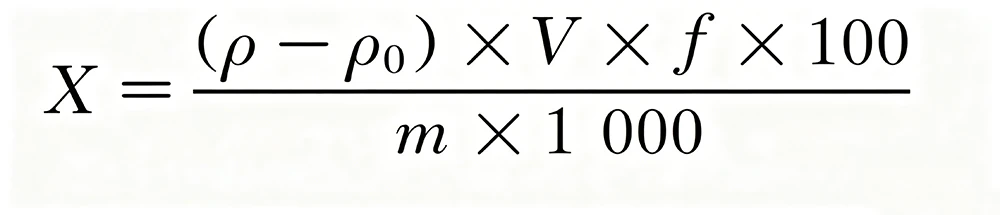
X — The content of the measured element in the sample, unit is mg / 100g or mg / 100mL (mg/100g or mg/100mL);
P — The mass concentration of elements in the determination solution, unit: mg/l (mg/L);
ρo — Determine the mass concentration of elements in the blank test solution, with the unit of milligrams per liter (mg/L);
V — Volume of sample solution, in milliliters (mL);
F — Dilution factor of sample solution;
100.1 000 — Conversion factor;
m — The mass or volume of the sample, in units of grams or milliliters (g or mL).
Conclusion: The absolute difference between two independent measurements under repetitive conditions should not exceed 10% of the arithmetic mean. When the sample volume is 0.5 g and the solution is diluted to 25 mL, the detection limit for potassium is 0.2 mg/100 g, and the quantification limit is 0.5 mg/100 g; the detection limit for sodium is 0.8 mg/100 g, and the quantification limit is 3 mg/100 g. The detection limit of the AA-1800C atomic absorption spectrometer is lower than that of the method, thus it can meet the method requirements.
P — The mass concentration of elements in the determination solution, unit: mg/l (mg/L);
ρo — Determine the mass concentration of elements in the blank test solution, with the unit of milligrams per liter (mg/L);
V — Volume of sample solution, in milliliters (mL);
F — Dilution factor of sample solution;
100.1 000 — Conversion factor;
m — The mass or volume of the sample, in units of grams or milliliters (g or mL).
Conclusion: The absolute difference between two independent measurements under repetitive conditions should not exceed 10% of the arithmetic mean. When the sample volume is 0.5 g and the solution is diluted to 25 mL, the detection limit for potassium is 0.2 mg/100 g, and the quantification limit is 0.5 mg/100 g; the detection limit for sodium is 0.8 mg/100 g, and the quantification limit is 3 mg/100 g. The detection limit of the AA-1800C atomic absorption spectrometer is lower than that of the method, thus it can meet the method requirements.
Instrument parameter
AA-1800C Atomic Absorption Spectrometer
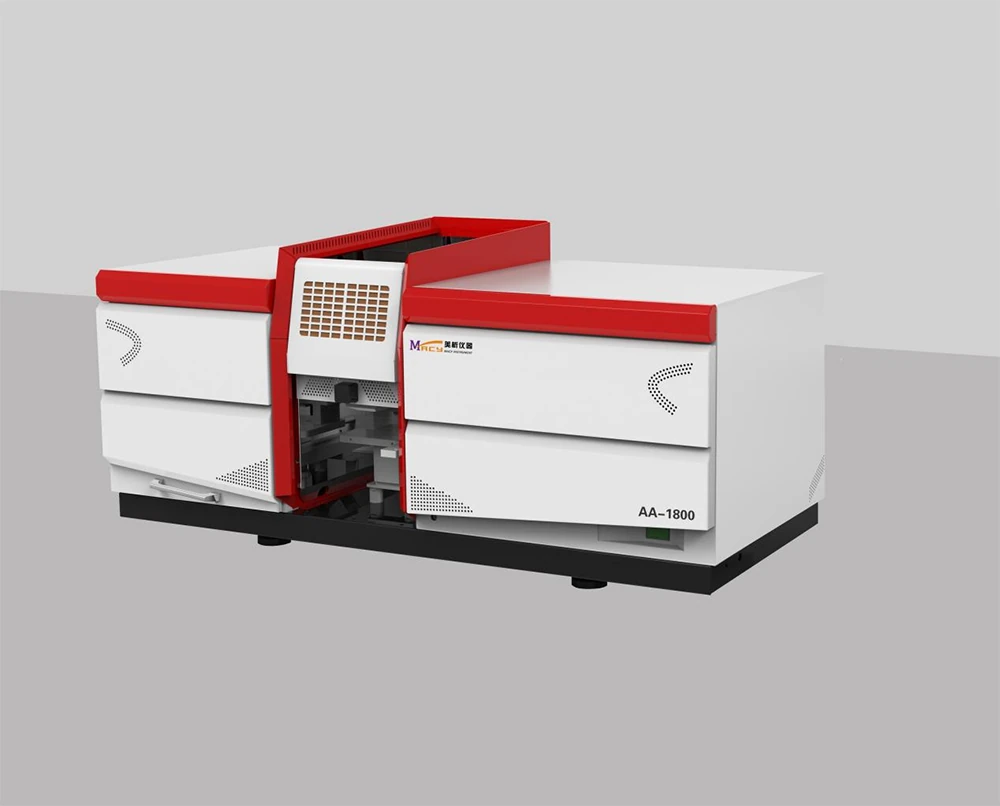
The flame atomic absorption spectrometer is capable of analyzing and determining both macro and trace inorganic elements.
Working conditions
Power supply:220V (+5%~-10%),50/60 Hz;5000VA
Environmental temperature:+15℃~+35℃
Relative humidity:20~80%
Environmental temperature:+15℃~+35℃
Relative humidity:20~80%
Specifications
Beam splitting system
Grating line density:≥1800 lines /mm
Effective grating line area: ≥50 x 50 mm²
wavelength range :190-900nm。
Spectral bandwidth :0.1、0.2、0.4、1.0、2.0nmFive levels of automatic adjustment, automatic setting of wavelength slit width and energy
Wavelength accuracy :≤0.15nm
Wavelength repeatability : ±0.1nm。
Baseline drift: static ≤ ±0.002A/30 minutes, dynamic ≤ ±0.005A/30 minutes.
Spectral resolution of the instrument: it can distinguish the double lines of 279.5nm and 279.8nm manganese, and when the spectral passband is 0.2nm/mm, the peak and valley energy between the two lines is less than or equal to 30%
Light source:Six lamps automatically switch to the turret and automatically align
Lightning current setting:0-30mA, Computer set automatically.
High performance power supply: built-in high performance lamp double cathode power supply.
Grating line density:≥1800 lines /mm
Effective grating line area: ≥50 x 50 mm²
wavelength range :190-900nm。
Spectral bandwidth :0.1、0.2、0.4、1.0、2.0nmFive levels of automatic adjustment, automatic setting of wavelength slit width and energy
Wavelength accuracy :≤0.15nm
Wavelength repeatability : ±0.1nm。
Baseline drift: static ≤ ±0.002A/30 minutes, dynamic ≤ ±0.005A/30 minutes.
Spectral resolution of the instrument: it can distinguish the double lines of 279.5nm and 279.8nm manganese, and when the spectral passband is 0.2nm/mm, the peak and valley energy between the two lines is less than or equal to 30%
Light source:Six lamps automatically switch to the turret and automatically align
Lightning current setting:0-30mA, Computer set automatically.
High performance power supply: built-in high performance lamp double cathode power supply.
Flame atomizer
*Characteristic concentration (Cu):0.015μg/mL/1%。
*Detection limit(Cu):0.002μg/mL。
*Precision:RSD≤0.5%。
Burning head: titanium burning head, 50mm or 100mm universal burning head.
Atomizer: Pt-Ir capillary, Teflon nozzle, ceramic impact ball (for use with hydrofluoric acid)
Atomization chamber: explosion-proof corrosion-resistant material atomization chamber.
Ignition mode: microcomputer control, automatic ignition.
Gas control: automatic gas control system
Regulation system: fully automatic PC control of flame/graphite furnace automatic switching, and automatic optimization.
Safety protection: it has automatic safety protection function, automatic gas circuit protection against flashback, acetylene leakage alarm, automatic shutdown system, and automatic power off in case of abnormality.
Background correction: flame: deuterium lamp + self-suction background correction: can correct 1A background.
*Detection limit(Cu):0.002μg/mL。
*Precision:RSD≤0.5%。
Burning head: titanium burning head, 50mm or 100mm universal burning head.
Atomizer: Pt-Ir capillary, Teflon nozzle, ceramic impact ball (for use with hydrofluoric acid)
Atomization chamber: explosion-proof corrosion-resistant material atomization chamber.
Ignition mode: microcomputer control, automatic ignition.
Gas control: automatic gas control system
Regulation system: fully automatic PC control of flame/graphite furnace automatic switching, and automatic optimization.
Safety protection: it has automatic safety protection function, automatic gas circuit protection against flashback, acetylene leakage alarm, automatic shutdown system, and automatic power off in case of abnormality.
Background correction: flame: deuterium lamp + self-suction background correction: can correct 1A background.
Data processing
Measurement methods: Flame method, hydride method.
Concentration calculation method: standard curve method (1~3 times curve), automatic fitting, standard addition method.
Number of repeated measurements: 1-99 times, calculate the average value, and give the standard deviation and relative standard deviation.
Result printing: parameter printing, data result printing, graphic printing, can be exported WORD, EXCEL documents.
The interface is all Chinese, the operation is simple and convenient, and automatic operation can be set through the software
*Communication interface: Communication between computer and host USB interface.
Concentration calculation method: standard curve method (1~3 times curve), automatic fitting, standard addition method.
Number of repeated measurements: 1-99 times, calculate the average value, and give the standard deviation and relative standard deviation.
Result printing: parameter printing, data result printing, graphic printing, can be exported WORD, EXCEL documents.
The interface is all Chinese, the operation is simple and convenient, and automatic operation can be set through the software
*Communication interface: Communication between computer and host USB interface.
About Us
Macylab Instrument Co., Ltd. (hereinafter referred to as Macylab) is a high-tech enterprise with independent intellectual property rights. The company’s founding philosophy,’ Technology —— Change for You,’ guides its mission to continuously explore and innovate boldly. In the field of analytical testing instruments, Meixi consistently develops advanced products, positioning itself as a supplier of high-quality instruments.
Macylab specializes in a wide range of spectrometric instruments, including visible spectrophotometers, UV-visible spectrophotometers, atomic absorption spectrometers, ultra-micro spectrophotometers, atomic fluorescence spectrometers, ICP (inductively coupled plasma) emission spectrometers, and ICP-MS (inductively coupled plasma mass spectrometers). Our products are widely used in fields such as organic chemistry, inorganic chemistry, biochemistry, pharmaceuticals, environmental protection, metallurgy, petroleum, and agriculture. Leveraging our extensive experience in product mechanical design, optical design, electrical applications, and software development, and by aligning with the latest market demands, we will soon introduce a series of new analytical instruments.
Meixie’s headquarters and production base are located in Shanghai, with its marketing center in Beijing. The company has also established R&D bases in Jiangsu, Shanghai, and Shandong. To leverage the intellectual resources of various regions, Meixie collaborates deeply with research institutions both domestically and internationally, continuously transforming research outcomes into practical applications. To better serve its customers, Meixie has set up 12 offices across China, offering customized application solutions to enhance the value of its products. While serving domestic users, Meixie has also formed deep strategic partnerships with distribution agencies in over 20 countries.
Macylab specializes in a wide range of spectrometric instruments, including visible spectrophotometers, UV-visible spectrophotometers, atomic absorption spectrometers, ultra-micro spectrophotometers, atomic fluorescence spectrometers, ICP (inductively coupled plasma) emission spectrometers, and ICP-MS (inductively coupled plasma mass spectrometers). Our products are widely used in fields such as organic chemistry, inorganic chemistry, biochemistry, pharmaceuticals, environmental protection, metallurgy, petroleum, and agriculture. Leveraging our extensive experience in product mechanical design, optical design, electrical applications, and software development, and by aligning with the latest market demands, we will soon introduce a series of new analytical instruments.
Meixie’s headquarters and production base are located in Shanghai, with its marketing center in Beijing. The company has also established R&D bases in Jiangsu, Shanghai, and Shandong. To leverage the intellectual resources of various regions, Meixie collaborates deeply with research institutions both domestically and internationally, continuously transforming research outcomes into practical applications. To better serve its customers, Meixie has set up 12 offices across China, offering customized application solutions to enhance the value of its products. While serving domestic users, Meixie has also formed deep strategic partnerships with distribution agencies in over 20 countries.
Ready to Implement This Solution?
Contact our application specialists for a customized quote and method validation.