
Abstract
As a spectrometric analytical technique, ultraviolet-visible (UV-Vis) spectrophotometry is widely adopted in drug content determination, featuring simple operation and high sensitivity. Nevertheless, its practical application is susceptible to interferences stemming from drug properties, reagent purity, instrument conditions and other factors, leading to deviations between measured results and true values. This paper systematically analyzes interference sources from perspectives including drug molecular structures, excipient compositions, reagent preparation and environmental conditions, and puts forward preventive and control measures such as optimized sample pretreatment, improved reagent quality, standardized instrument calibration and maintenance. The innovation of this study lies in integrating spectrometric principles with laboratory quality systems to establish a systematic framework for interference prevention and control. The introduction of standardized operating procedures and system suitability tests can effectively enhance the accuracy and repeatability of drug content detection. This research bears great significance for improving the reliability of laboratory testing and advancing the scientization of pharmaceutical analytical methods.
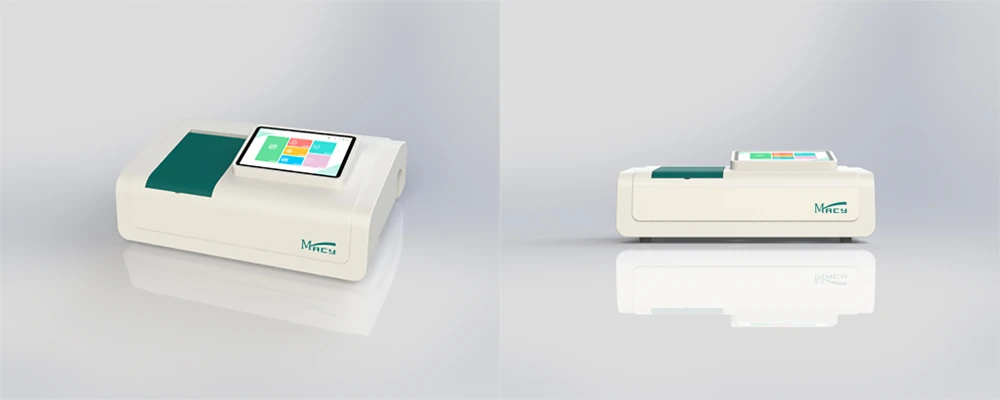
Instrument Display of UV-Vis Spectrophotometer
Introduction
UV-Vis spectrophotometry boasts a long application history in pharmaceutical analysis and has become an essential technique for drug research & development and quality inspection. It enables qualitative identification and quantitative assay of pharmaceuticals by measuring the characteristic light absorption of molecules within ultraviolet and visible spectral regions. Chen Huoyou stated that based on the principle of light absorption, this method can realize highly sensitive determination of drug contents within a short timeframe, presenting favorable stability and versatility in water quality and pharmaceutical analysis. Ma Chunhua et al. pointed out that with the increasingly complex structures of pharmaceutical preparations and excipient compositions, spectral interference of UV absorption peaks becomes more prominent, readily triggering linear deviations and measurement errors. Research by Zhou Jinhong et al. demonstrated that experimental conditions, light source attenuation and environmental fluctuations may degrade the repeatability of test results. Therefore, in-depth analysis of the formation mechanism of interferences and establishment of systematic prevention strategies are critical to guarantee the accuracy and comparability of drug content determination. This paper summarizes typical interference factors of UV-Vis spectrophotometry in pharmaceutical content testing and proposes targeted prevention, control and optimization strategies. By constructing a systematic analytical framework and experimental interference control workflow, it provides theoretical support and practical references for improving the precision, stability and standardization of pharmaceutical detection.
1 Working Principle of UV-Vis Spectrophotometry
The core mechanism of UV-Vis spectrophotometry relies on molecular light absorption at specific wavelengths, originating from electron transitions between ground states and excited states within molecules. Photons in the ultraviolet range carry sufficient energy to induce transitions of π-electrons or non-bonding electrons. Pharmaceutical molecules containing conjugated double bonds, benzene rings and carbonyl groups generally exhibit distinct absorption peaks within the 200–400 nm ultraviolet region.
Molecules with benzene ring structures show maximum absorption wavelengths ranging from 250 nm to 280 nm. This property endows benzene-containing drugs with high absorbance at this wavelength range, facilitating quantitative analysis. Carbonyl groups produce moderate-intensity absorption peaks at 190–210 nm; the positions of such peaks can be used to identify the presence and transformation of carbonyl moieties in drug molecules, serving as a vital indicator for monitoring drug degradation or oxidation reactions. Conjugated double bond systems generate intense absorption bands at 220–280 nm, which are highly sensitive to the degree of molecular conjugation. Extension or cleavage of conjugated systems in drug molecules will induce measurable shifts in absorption peak positions and intensities, which can be utilized to monitor structural changes and purity differences.
Quantitative analysis is normally performed based on the correlation between absorbance and concentration. In accordance with the Beer-Lambert Law, absorbance is linearly proportional to concentration within a certain concentration range. Measurements yield optimal accuracy when the absorbance readings of drug solutions fall between 0.3 and 0.7, corresponding to concentration ranges with satisfactory linearity and a coefficient of determination (r²) approaching 0.999. If concentrations exceed the linear range, enhanced intermolecular forces or stray light interference will cause linear deviations and compromise quantitative precision. Accordingly, analysts must select appropriate wavelengths and concentration ranges for drug content assays to ensure sufficient sensitivity and reliability of measurements.
Molecules with benzene ring structures show maximum absorption wavelengths ranging from 250 nm to 280 nm. This property endows benzene-containing drugs with high absorbance at this wavelength range, facilitating quantitative analysis. Carbonyl groups produce moderate-intensity absorption peaks at 190–210 nm; the positions of such peaks can be used to identify the presence and transformation of carbonyl moieties in drug molecules, serving as a vital indicator for monitoring drug degradation or oxidation reactions. Conjugated double bond systems generate intense absorption bands at 220–280 nm, which are highly sensitive to the degree of molecular conjugation. Extension or cleavage of conjugated systems in drug molecules will induce measurable shifts in absorption peak positions and intensities, which can be utilized to monitor structural changes and purity differences.
Quantitative analysis is normally performed based on the correlation between absorbance and concentration. In accordance with the Beer-Lambert Law, absorbance is linearly proportional to concentration within a certain concentration range. Measurements yield optimal accuracy when the absorbance readings of drug solutions fall between 0.3 and 0.7, corresponding to concentration ranges with satisfactory linearity and a coefficient of determination (r²) approaching 0.999. If concentrations exceed the linear range, enhanced intermolecular forces or stray light interference will cause linear deviations and compromise quantitative precision. Accordingly, analysts must select appropriate wavelengths and concentration ranges for drug content assays to ensure sufficient sensitivity and reliability of measurements.
2 Common Interference Factors in Drug Content Determination via UV-Vis Spectrophotometry
2.1 Interferences Arising from Physicochemical Properties and Degradation of Drugs
The UV-visible absorption profiles of drug molecules are jointly determined by their chemical structures and stability, and variations in these profiles directly distort absorbance curves and impair quantitative accuracy. Light exposure frequently triggers photodegradation of molecules. After 30 minutes of irradiation at 254 nm, the maximum absorption peak of penicillin antibiotics decreases by over 15%, while their degradation products form new absorption bands at 200–230 nm that overlap the original signal and drastically reduce detection sensitivity.
Temperature is another critical influencing factor. Storage of paracetamol solutions at 37 °C for 48 hours generates oxidation byproducts whose absorption peaks at 296 nm overlap the main peak, leading to overestimated drug contents. Minor pH variations alter the ionization state of drug molecules and thereby modify their light absorption behavior. Chloramphenicol maintains optimal stability at pH 7.0, yet its degradation rate rises sharply at pH 8.0, accompanied by new absorption peaks at 260 nm that break the linear relationship between concentration and absorbance.
In addition, formulation excipients and batch impurities constitute another non-negligible source of interference. Starch produces broad absorption bands at 210–230 nm, elevating the baseline when its content exceeds 5%; lactose induces baseline fluctuations at wavelengths shorter than 200 nm. Impurities such as p-aminophenol and benzoquinone generate strong absorption peaks at 240–260 nm overlapping the main drug signal, resulting in distorted peak shapes.
Temperature is another critical influencing factor. Storage of paracetamol solutions at 37 °C for 48 hours generates oxidation byproducts whose absorption peaks at 296 nm overlap the main peak, leading to overestimated drug contents. Minor pH variations alter the ionization state of drug molecules and thereby modify their light absorption behavior. Chloramphenicol maintains optimal stability at pH 7.0, yet its degradation rate rises sharply at pH 8.0, accompanied by new absorption peaks at 260 nm that break the linear relationship between concentration and absorbance.
In addition, formulation excipients and batch impurities constitute another non-negligible source of interference. Starch produces broad absorption bands at 210–230 nm, elevating the baseline when its content exceeds 5%; lactose induces baseline fluctuations at wavelengths shorter than 200 nm. Impurities such as p-aminophenol and benzoquinone generate strong absorption peaks at 240–260 nm overlapping the main drug signal, resulting in distorted peak shapes.
2.2 Reagent Purity and Operational Deviations
The reliability of analytical systems is predominantly governed by reagent purity and instrument performance. Spectroscopic-grade or chromatographic-grade methanol should possess transmittance higher than 95% at 200 nm. In contrast, conventional analytical-grade reagents exhibit an absorbance of 0.02 AU at 205 nm, which overestimates results of low-concentration samples. Laboratories shall establish a dedicated management system for high-purity reagents to guarantee analytical consistency.
The status of light sources and cuvettes is equally critical. After over 1000 hours of operation, deuterium lamps suffer approximately 30% light intensity attenuation, causing baseline fluctuations exceeding ±0.005 AU. A cuvette path length error exceeding ±0.01 cm introduces a systematic error of roughly 1%. Systematic assurance of measurement precision can be achieved through tiered reagent management, defined light source replacement cycles and regular cuvette verification protocols.
The status of light sources and cuvettes is equally critical. After over 1000 hours of operation, deuterium lamps suffer approximately 30% light intensity attenuation, causing baseline fluctuations exceeding ±0.005 AU. A cuvette path length error exceeding ±0.01 cm introduces a systematic error of roughly 1%. Systematic assurance of measurement precision can be achieved through tiered reagent management, defined light source replacement cycles and regular cuvette verification protocols.
2.3 Instrument Performance Degradation and Environmental Disturbances
Fluctuations in instrument conditions and experimental environments represent major external error sources for determination. Aging light sources reduce energy output: deuterium lamps lose around 30% intensity after 1000 hours of service, triggering baseline drift beyond ±0.005 AU and undermining accuracy for low-concentration samples. Tungsten lamps deliver decreased signal-to-noise ratios above 600 nm, which also reduces detection sensitivity.
The optical integrity of cuvettes directly governs absorbance stability. A path length error exceeding ±0.01 cm results in up to 1% systematic error; surface scratches or contaminants scatter incident light and destabilize analytical signals. Environmental variations further exacerbate instrument drift risks. When laboratory relative humidity exceeds 70%, air absorption intensifies in the short-wavelength ultraviolet region, doubling baseline noise. Every 5 °C rise in ambient temperature increases detector dark current by approximately 10%, lifting background signals. If stray light proportion surpasses 0.1%, samples with absorbance below 0.2 may carry measurement errors of up to 5%.
The optical integrity of cuvettes directly governs absorbance stability. A path length error exceeding ±0.01 cm results in up to 1% systematic error; surface scratches or contaminants scatter incident light and destabilize analytical signals. Environmental variations further exacerbate instrument drift risks. When laboratory relative humidity exceeds 70%, air absorption intensifies in the short-wavelength ultraviolet region, doubling baseline noise. Every 5 °C rise in ambient temperature increases detector dark current by approximately 10%, lifting background signals. If stray light proportion surpasses 0.1%, samples with absorbance below 0.2 may carry measurement errors of up to 5%.
3 Experimental Prevention Strategies and Quality Assurance Framework for Interference Control
3.1 Optimization of Sample Pretreatment and Reagent Quality Control
Sample pretreatment constitutes the initial stage of drug content determination. Appropriate extraction and purification effectively mitigate spectral interferences. Solid formulations such as tablets and capsules generate insoluble particles during dissolution, which scatter incident light and destabilize absorbance curves. Particles with diameters ranging from 1 μm to 10 μm significantly intensify scattered light, attenuating effective optical path length and inducing measurement deviations up to ±0.02 AU, with more severe errors observed for low-concentration specimens. To mitigate this effect, samples shall be centrifuged at 3000 r/min or filtered through 0.45 μm membranes prior to measurement to obtain clear solutions and suppress baseline noise.
For systems featuring overlapping interference peaks, masking agents can be applied. Metal ions readily form complexes with pharmaceutical ingredients and produce extra absorption bands across the spectral range; 0.01 mol/L ethylenediaminetetraacetic acid (EDTA) efficiently chelates metal ions and eliminates corresponding interferences.
Exposure to ambient light for 6 hours at room temperature accelerates drug photodegradation: paracetamol degradation rate exceeds 20%, and its degradation products form absorption bands at 260 nm that severely interfere with quantitation. Addition of 0.005 mol/L sodium bisulfite as an antioxidant effectively suppresses oxidation reactions. For drugs sensitive to environmental conditions, buffer stabilizers are supplemented into test solutions. Salicylate pharmaceuticals are prone to hydrolysis under neutral conditions, while citrate buffer systems reduce their hydrolysis rate by over 50%, stabilizing molecular structures.
Reagent purity and storage conditions directly affect measurement accuracy. Methanol and acetonitrile used for analysis must meet spectroscopic or chromatographic grade specifications with transmittance above 95% at 200 nm. Conventional analytical-grade reagents generate background absorption at short wavelengths (e.g., 0.02 AU absorbance at 205 nm), raising baseline levels when employed for sample dissolution. Laboratories shall implement tiered reagent usage rules: high-purity reagents are reserved for quantitative assays, while general-grade reagents are only utilized for cleaning or preliminary treatment. Optimized sample processing paired with rigorous reagent quality control eliminates interferences at the source.
For systems featuring overlapping interference peaks, masking agents can be applied. Metal ions readily form complexes with pharmaceutical ingredients and produce extra absorption bands across the spectral range; 0.01 mol/L ethylenediaminetetraacetic acid (EDTA) efficiently chelates metal ions and eliminates corresponding interferences.
Exposure to ambient light for 6 hours at room temperature accelerates drug photodegradation: paracetamol degradation rate exceeds 20%, and its degradation products form absorption bands at 260 nm that severely interfere with quantitation. Addition of 0.005 mol/L sodium bisulfite as an antioxidant effectively suppresses oxidation reactions. For drugs sensitive to environmental conditions, buffer stabilizers are supplemented into test solutions. Salicylate pharmaceuticals are prone to hydrolysis under neutral conditions, while citrate buffer systems reduce their hydrolysis rate by over 50%, stabilizing molecular structures.
Reagent purity and storage conditions directly affect measurement accuracy. Methanol and acetonitrile used for analysis must meet spectroscopic or chromatographic grade specifications with transmittance above 95% at 200 nm. Conventional analytical-grade reagents generate background absorption at short wavelengths (e.g., 0.02 AU absorbance at 205 nm), raising baseline levels when employed for sample dissolution. Laboratories shall implement tiered reagent usage rules: high-purity reagents are reserved for quantitative assays, while general-grade reagents are only utilized for cleaning or preliminary treatment. Optimized sample processing paired with rigorous reagent quality control eliminates interferences at the source.
3.2 Methodological Correction Techniques and Detection Parameter Optimization
In practical UV-Vis applications, background noise, peak overlap and instrument drift compromise the reliability of quantitative results. Analysts adopt multiple correction techniques to reduce systematic errors and enhance signal resolution, including dual-wavelength spectrophotometry, differential spectrophotometry and baseline correction, each with distinct principles and applicable scopes (see Table 1).

Optimization of detection parameters is equally indispensable. Cuvette path length precision directly impacts test outcomes: 1.00 cm cuvettes must feature path length errors less than ±0.005 cm to avoid systematic errors exceeding 1%. Cuvette surfaces shall remain clean and transparent, as scratches and residues induce light scattering and distort absorbance readings. Strict light source maintenance protocols shall be enforced: deuterium lamps with service time over 1000 hours lose 30% intensity and must be replaced promptly to prevent compromised detection of low-concentration pharmaceuticals. Instrument calibration using standard filters verifies wavelength and absorbance accuracy, with wavelength error controlled within ±0.2 nm and absorbance error limited to ±0.003 AU. Such correction and optimization measures ensure high accuracy and repeatability in drug content determination.
3.3 Standardized Operating Protocols and Full-Process Quality Monitoring
Establishment of standardized operating systems is pivotal to guaranteeing testing reliability. Laboratories shall formulate detailed standard operating procedures (SOPs) in compliance with the Chinese Pharmacopoeia and international guidelines, specifying requirements for sample pretreatment, reagent preparation and instrument operation. Buffers shall be prepared with calibrated pH meters with permissible pH deviation within ±0.02. Vitamin solutions shall be stored at 4 °C under light-proof conditions and analyzed within 12 hours to avoid interference from degradation products. Introduction of System Suitability Tests (SST) enables real-time monitoring of method reliability. Reference samples or standard substances are tested prior to measurement to validate system performance; systems failing to meet criteria (resolution below 2.0 or baseline noise exceeding 0.005 AU) require reconditioning.
A full-process quality monitoring system ensures full data traceability. Laboratories shall record detailed information including sample serial numbers, reagent origins and instrument status to achieve traceability of all analytical steps. Method validation shall comply with requirements stipulated in the Chinese Pharmacopoeia and the ICH Guidelines for Pharmaceutical Registration, with separate evaluation of accuracy, precision and linearity. During method validation, standard recovery rates shall be maintained between 98% and 102%, and relative standard deviation (RSD) shall not exceed 2%. Synergies between standardized SOPs, SST monitoring (SST evaluates overall system performance by detecting key indicators including resolution, peak symmetry and signal-to-noise ratio of standard samples) and quality system management enable laboratories to deliver consistent drug content determination results, facilitating broader application of UV-Vis spectrophotometry in pharmaceutical quality evaluation and clinical practice.
A full-process quality monitoring system ensures full data traceability. Laboratories shall record detailed information including sample serial numbers, reagent origins and instrument status to achieve traceability of all analytical steps. Method validation shall comply with requirements stipulated in the Chinese Pharmacopoeia and the ICH Guidelines for Pharmaceutical Registration, with separate evaluation of accuracy, precision and linearity. During method validation, standard recovery rates shall be maintained between 98% and 102%, and relative standard deviation (RSD) shall not exceed 2%. Synergies between standardized SOPs, SST monitoring (SST evaluates overall system performance by detecting key indicators including resolution, peak symmetry and signal-to-noise ratio of standard samples) and quality system management enable laboratories to deliver consistent drug content determination results, facilitating broader application of UV-Vis spectrophotometry in pharmaceutical quality evaluation and clinical practice.
4 Discussion and Conclusion
As a spectrometric technique, UV-Vis spectrophotometry is widely utilized for drug content determination due to its simple operation and high sensitivity. However, its practical performance is vulnerable to interferences originating from drug intrinsic properties, reagent preparation standards, instrument stability and other factors, leading to discrepancies between measured values and true drug contents. This paper systematically analyzes interference formation mechanisms from molecular structures, excipient effects, reagent quality and instrument stability perspectives, and verifies that intensified sample pretreatment, strict reagent quality control, improved instrument maintenance and calibration specifications can effectively mitigate external interferences and secure accurate, stable quantitative pharmaceutical detection.
The novelty of this research lies in integrating light absorption spectrometry rules with laboratory quality management systems to construct an operable workflow for interference prevention and control. Future research will further combine intelligent analytical algorithms and real-time monitoring technologies to realize dynamic correction and trend prediction during measurement, promoting the intelligentization and standardization of UV-Vis.
The novelty of this research lies in integrating light absorption spectrometry rules with laboratory quality management systems to construct an operable workflow for interference prevention and control. Future research will further combine intelligent analytical algorithms and real-time monitoring technologies to realize dynamic correction and trend prediction during measurement, promoting the intelligentization and standardization of UV-Vis.
Ready to Implement This Solution?
Contact our application specialists for a customized quote and method validation.