
1. Scope
This method specifies the liquid chromatography-tandem mass spectrometry determination of vitamin B1, vitamin B2, pantothenic acid, vitamin B6, biotin, folic acid, vitamin B12, nicotinate and nicotinamide in health food. This method is applicable to the determination of vitamin B1, vitamin B2, pantothenic acid, vitamin B6, biotin, folic acid, vitamin B12, niacin, and nicotinamide in nutrient supplement health foods.
2. Principle
This method specifies the liquid chromatography-tandem mass spectrometry determination of vitamin B1, vitamin B2, pantothenic acid, vitamin B6, biotin, folic acid, vitamin B12, nicotinate and nicotinamide in health food. This method is applicable to the determination of vitamin B1, vitamin B2, pantothenic acid, vitamin B6, biotin, folic acid, vitamin B12, niacin, and nicotinamide in nutrient supplement health foods.
3. Reagents and materials
Note: Unless otherwise specified, the reagents used in this method are analytical pure and the water is the primary water specified in GB / T 6682.
3.1 Reagent
3.1.1 Methanol: MS level.
3.1.2 Formic acid: MS level.
3.1.3 Ammonia water: 26% content.
3.1.4 Glacial acetic acid.
3.1.5 concentrated hydrochloric acid.
3.1.6 Ammonia (1+5) : Measure 100 mL of ammonia (3.1.3) and slowly pour 500 mL of water, mix well.
3.1.7 Hydrochloric acid (0.01 mol/L) : 9 mL concentrated hydrochloric acid (3.1.5) is absorbed and dissolved in 1000 mL water. Absorb 50 mL of the solution, dilute it with water and volume it to 500 mL.
3.1.8 0.1% formic acid aqueous solution: Dilute formic acid 1 mL with water to 1 000 mL, filter with filter membrane (3.4) for reserve use.
3.1.9 0.1% formic acid methanol solution: Take formic acid 1 mL, dilute it with methanol to 1000 ml, and filter it with filter membrane (3.4) for reserve use.
3.1.2 Formic acid: MS level.
3.1.3 Ammonia water: 26% content.
3.1.4 Glacial acetic acid.
3.1.5 concentrated hydrochloric acid.
3.1.6 Ammonia (1+5) : Measure 100 mL of ammonia (3.1.3) and slowly pour 500 mL of water, mix well.
3.1.7 Hydrochloric acid (0.01 mol/L) : 9 mL concentrated hydrochloric acid (3.1.5) is absorbed and dissolved in 1000 mL water. Absorb 50 mL of the solution, dilute it with water and volume it to 500 mL.
3.1.8 0.1% formic acid aqueous solution: Dilute formic acid 1 mL with water to 1 000 mL, filter with filter membrane (3.4) for reserve use.
3.1.9 0.1% formic acid methanol solution: Take formic acid 1 mL, dilute it with methanol to 1000 ml, and filter it with filter membrane (3.4) for reserve use.
3.2 Standard
Vitamin B1 (thiamine hydrochloride), vitamin B2, pantothate (calcium pantothenate pantothenate), vitamin B6 (pyridoxine), biotin, folic acid, vitamin B12, nicotinic acid, nicotinamide standard in Chinese name, English name, CAS accession number, molecular formula, relative molecular weight see Table A.1 of Appendix A, purity of 98%.
3.3 Standard solution preparation
3.3.1 Standard stock solution (1 mg/mL)
3.3.1.1 Vitamin B1 standard reserve liquid: Weigh vitamin B1 standard (3.2) 0.1g (accurate to 0.000 1 g), dissolve it with 0.01 mol/L hydrochloric acid (3.1.7) and fix it in 100 mL brown volumetric bottle.
3.3.1.2 Vitamin B2, biotin and folic acid standard reserve liquid: Weigh the biotin and folic acid standard (3.2) 0.1g (accurate to 0.000 1g), add 30 mL ammonia (3.1.6), dissolve, adjust the pH value of formic acid to 7.0, transfer with water and fix the volume into 100 mL brown volumetric bottle.
3.3.1.3 Vitamin B6, vitamin B12, niacin, niacinamide and pantothenic acid standard reserve liquid: Take vitamin B6, vitamin B12, niacin, niacinamide and pantothenic acid standard (3.2) 0.1g (accurate to 0.000 1g), dissolve them with water and fill them in 100 mL brown volumetric bottle.
3.3.1.2 Vitamin B2, biotin and folic acid standard reserve liquid: Weigh the biotin and folic acid standard (3.2) 0.1g (accurate to 0.000 1g), add 30 mL ammonia (3.1.6), dissolve, adjust the pH value of formic acid to 7.0, transfer with water and fix the volume into 100 mL brown volumetric bottle.
3.3.1.3 Vitamin B6, vitamin B12, niacin, niacinamide and pantothenic acid standard reserve liquid: Take vitamin B6, vitamin B12, niacin, niacinamide and pantothenic acid standard (3.2) 0.1g (accurate to 0.000 1g), dissolve them with water and fill them in 100 mL brown volumetric bottle.
3.3.2 Preparation of the blank matrix solution
Take the blank sample according to the sample preparation method (5.2).
3.3.3 Matrix-based standard working fluid
3.3.3.1 Vitamin B1 matrix standard working solution: accurately absorb the appropriate amount of vitamin B1 standard reserve solution (3.3.1), and dilute the blank matrix solution (3.3.2) into the matrix standard working solution containing 0.01 µ g/mL, 0.05 µ g/mL, 0.1 µ g/mL, 0.5 µ g/mL and 1 µ g/mL, respectively.
3.3.3.2 Eight kinds of vitamin matrix mixed standard working solution: accurately absorb vitamin B2, pantothenic acid, biotin, vitamin B6, folic acid, vitamin B12, nicotinate, nicotinamide standard reserve solution (3.3.1), with blank matrix solution diluted into 0.01 µ g/mL, 0.05 µ g/mL, 0.1 µ g/mL, 0.5 µ g/mL, 1 µ g/mL.
Note: The operation process shall be carried out in the light-avoidance environment.
3.3.3.2 Eight kinds of vitamin matrix mixed standard working solution: accurately absorb vitamin B2, pantothenic acid, biotin, vitamin B6, folic acid, vitamin B12, nicotinate, nicotinamide standard reserve solution (3.3.1), with blank matrix solution diluted into 0.01 µ g/mL, 0.05 µ g/mL, 0.1 µ g/mL, 0.5 µ g/mL, 1 µ g/mL.
Note: The operation process shall be carried out in the light-avoidance environment.
3.4 Microporous filter membrane: 0.22µm, organic phase
4. Instruments and equipment
4.1 High-performance liquid chromatography-tandem mass spectrometer: equipped with an electrospray ion source.
4.2 Ultrasonic cleaner
4.3 Analytical balance: Sensitivity was 0.01 g and 0.000 1 g, respectively.
4.2 Ultrasonic cleaner
4.3 Analytical balance: Sensitivity was 0.01 g and 0.000 1 g, respectively.
5. Analytical procedure
5.1 Sample preparation
The 20 tablets or capsules were crushed and mixed, and the liquid samples were mixed evenly.
5.2 Sample extraction
Accurately weigh 2g of evenly mixed sample (accurate to 0.01 g) into a 50 mL brown volumetric flask, add 40 mL water, sonicated for 10 min, cool to room temperature, take water to volume, shake well, the supernatant was filtered by microporous filter membrane (3.4), and measured by supply liquid chromatography-tandem mass spectrometer.
Note: The operation process shall be carried out in the light-avoidance environment.
Note: The operation process shall be carried out in the light-avoidance environment.
5.3 Instrument reference condition
5.3.1 Chromatographic condition
a)Chromatographic column: HSS T3 column, 1.8 μm, 100 mm×2.1 mm (inner diameter), or equivalent performance;
b)Mobile phase: A is 0.1% formic acid aqueous solution (3.1.8), B is 0.1% formic acid methanol solution (3.1.9), and the elution gradient is shown in Table 1.
c)Flow rate: 0.3mL /min;
d)Column temperature: 30℃;
e)Intake quantity: 2 μ L.
b)Mobile phase: A is 0.1% formic acid aqueous solution (3.1.8), B is 0.1% formic acid methanol solution (3.1.9), and the elution gradient is shown in Table 1.
c)Flow rate: 0.3mL /min;
d)Column temperature: 30℃;
e)Intake quantity: 2 μ L.
Table 1: Elution gradient
| Time(min) | Mobile phase A(%) | Mobile phase B(%) |
| 0 | 99 | 1 |
| 3 | 99 | 1 |
| 5 | 5 | 95 |
| 8 | 50 | 50 |
| 10 | 99 | 1 |
| 15 | 99 | 1 |
5.3.2 Mass spectrum condition
a)Ionization mode: electrospray positive ion mode.
b)Detection method: Multi-response detection (MRM)
c)Atomizing gas pressure: 45psi.
d)Ion spray voltage: 3500V.
e)Dry temperature: 300℃.
f)Dry gas flow rate: 5 L/min.
g)Qualitative ion pairs, quantitative ions, fragmentation voltage and collision energy are shown in Table 2.
b)Detection method: Multi-response detection (MRM)
c)Atomizing gas pressure: 45psi.
d)Ion spray voltage: 3500V.
e)Dry temperature: 300℃.
f)Dry gas flow rate: 5 L/min.
g)Qualitative ion pairs, quantitative ions, fragmentation voltage and collision energy are shown in Table 2.
Table 2 Qualitative ion pairs, quantitative ions, fragmentation voltage, and collision energy of water-soluble vitamins
| Name | Parent ion (m/z) | Daughter ion (m/z) | Fragmentor· ( V) | Collision energy(eV) |
| vitamin B₁ | 265.1 | 122.2*;144.1 | 100 | 15;15 |
| vitamin B₂ | 377.1 | 243.1*;172.2 | 135 | 25;32 |
| pantothenic acid | 220.2 | 90.1*;184.2 | 100 | 10;20 |
| vitamin B6 | 170.2 | 152.1*;134.1 | 100 | 12;22 |
| biotin | 245.1 | 227.1*;97.1 | 100 | 12;22 |
| folic acid | 442.1 | 295.1*;176.2 | 100 | 10;40 |
| vitamin B12 | 679.4 | 147.2*;359.1 | 200 | 20;40 |
| niacin | 124.1 | 80.1*;78.1 | 100 | 28;32 |
| nicotinamide | 123.1 | 80.1*;53.1 | 100 | 5;5 |
5.4 Qualitative test
Determine the test sample and the mixed standard working solution according to the above conditions, if the retention time of the mass chromatography peak in the test sample is consistent with some component in the mixed standard working solution (within ± 2.5%); the relative abundance of qualitative ion pairs and the concentration of the mixed standard working solution do not exceed the range specified in Table 3, it can be determined that this component exists in the test sample.
Table 3 Maximum allowable deviation in relative ion abundance for qualitative confirmation
| Relative ion abundance(%) | >50 | >20~50 | >10~20 | ≤10 |
| Maximum allowable deviation allowed(%) | ± 20 | ± 25 | ± 30 | ± 50 |
5.5 Quantitative determination
5.5.1 Production of standard curves
The matrix standard working solution (3.3.3) was determined according to the instrument reference condition (5.3) to obtain the chromatographic peak area of the corresponding standard solution. The standard curve was drawn using the concentration of the matrix standard working solution as the abscissa and the peak area of the chromatographic peak as the ordinate.
5.5.2 Determination of sample solution
The sample solution (5.2) was determined according to the instrument reference condition (5.3) to obtain the chromatographic peak area of the corresponding sample solution. The concentration of components in the solution according to the standard curve, and the parallel measurement is no less than twice; if the response value of the sample is lower than the linear range of the standard curve, take the filtrate in 5.2 for analysis; if the response value of the sample exceeds the linear range of the standard curve, analyze after dilution with water.
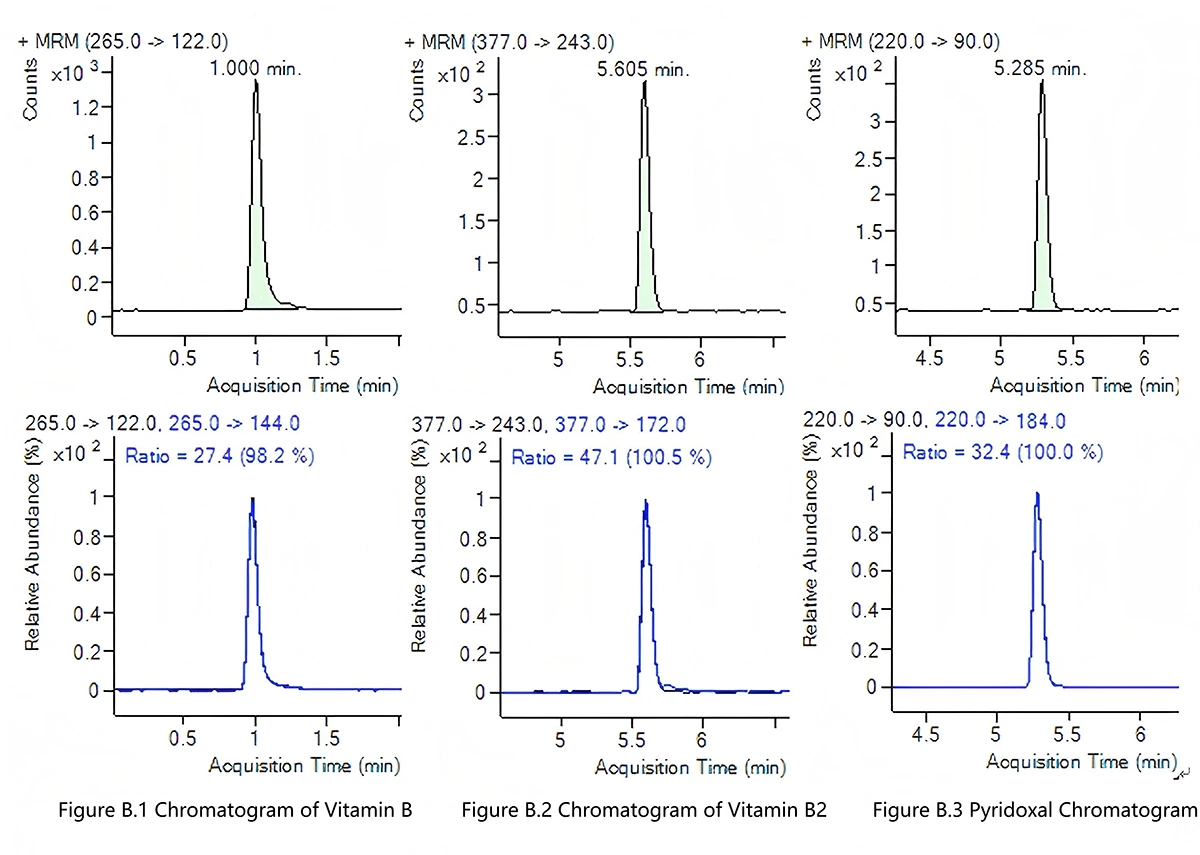
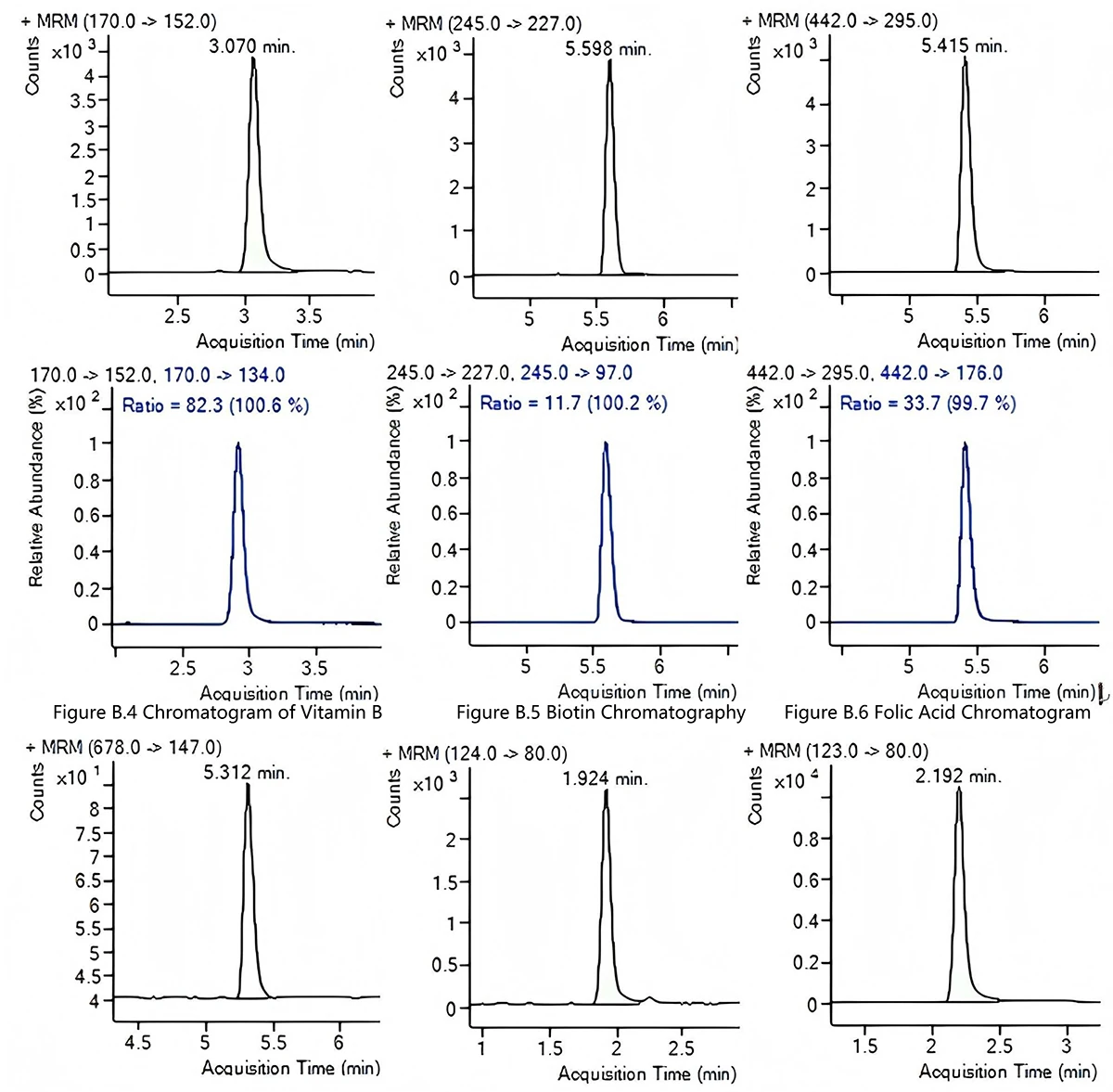
The liquid chromatogram of the standard product is shown in Figure B.1-B.9 in Appendix B.
The liquid chromatogram of the standard product is shown in Figure B.1-B.9 in Appendix B.
6. Results are calculated
The results are calculated according to the formula: (1):
In formula:
X- -the content of a certain component in the sample, measured in microgram per 100g (μ g / 100 g);
C- -the concentration of a component in the sample solution derived from the standard curve in micrograms per milliliter (μg/mL);
V-Fixed volume of sample solution in milliliter (mL);
M- -Quality of sample weighing in grams (g);
The calculated results are expressed as the arithmetic mean of two independent
measurements obtained under the condition of repeatability, and the results retain three
significant digits.
X- -the content of a certain component in the sample, measured in microgram per 100g (μ g / 100 g);
C- -the concentration of a component in the sample solution derived from the standard curve in micrograms per milliliter (μg/mL);
V-Fixed volume of sample solution in milliliter (mL);
M- -Quality of sample weighing in grams (g);
The calculated results are expressed as the arithmetic mean of two independent
measurements obtained under the condition of repeatability, and the results retain three
significant digits.
7. Precision
The absolute difference between the two independent assays obtained in repeated conditions
shall not exceed 10% of the arithmetic mean.
shall not exceed 10% of the arithmetic mean.
8. Other
When the sample quantity is 2.00 g and the fixed volume is 50 mL, the detection limit of vitamin B1, vitamin B6 and folic acid is 2.5 μ g / 100g and the limit of quantification is 10 μ g / 100g; the detection limit of vitamin B2, pantothenic acid, niacin and nicotinamide is 5 μ g / 100g / 100g and the detection limit of biotin and vitamin B12 is 7.5 μ g / 100g and 25 μ g / 100g.
Appendix A
Appendix A
Water-soluble vitamin standard product information
Table A.1 Chinese name, English name, CAS login number, molecular formula and relative molecular weight of water-soluble vitamin standards
| NO. | Name | CASaccession number | Molecular formula | Relative molecular weight |
| 1 | Thiamine | 59-43-8 | C12H17ClN4OS | 264.35 |
| 2 | Riboflavin | 83-88-5 | C17H20N4O6 | 376.37 |
| 3 | Pantothenic Acid | 137-08-6 | C9H17NO5 | 219.23 |
| 4 | Pyridoxine | 65-23-6 | C8H11NO3 | 169.18 |
| 5 | Biotin | 58-85-5 | C10H16N2O3S | 244.30 |
| 6 | Folic Acid | 53-30-3 | C19H19N7O6 | 441.40 |
| 7 | Vitamin B12 | 200-680-0 | C63H88CoN14O14P | 1355.37 |
| 8 | Nicotinic Acid | 59-67-6 | C6H5NO2 | 123.11 |
| 9 | Nicotinamide | 98-92-0 | C6H6N2O | 122.13 |
Appendix B
Chromatogram of water soluble vitamin standard
Ready to Implement This Solution?
Contact our application specialists for a customized quote and method validation.