
1 Scope
This method is applicable to the ultraviolet spectrophotometric determination of total capsaicin content in chillies and their oleoresins.
2 Normative References
ISO 948 Spices and condiments – Sampling
ISO 2825 Spices and condiments – Preparation of ground sample for analysis
ISO 2825 Spices and condiments – Preparation of ground sample for analysis
3 Principle
The ultraviolet absorbance of methanolic solutions of chilli extracts or chilli oleoresins is measured at wavelengths of 248 nm and 296 nm. The total capsaicin content in the sample is calculated based on the absorbance values.
4 Reagents
The ultraviolet absorbance of methanolic solutions of chilli extracts or chilli oleoresins is measured at wavelengths of 248 nm and 296 nm. The total capsaicin content in the sample is calculated based on the absorbance values.
5 Apparatus
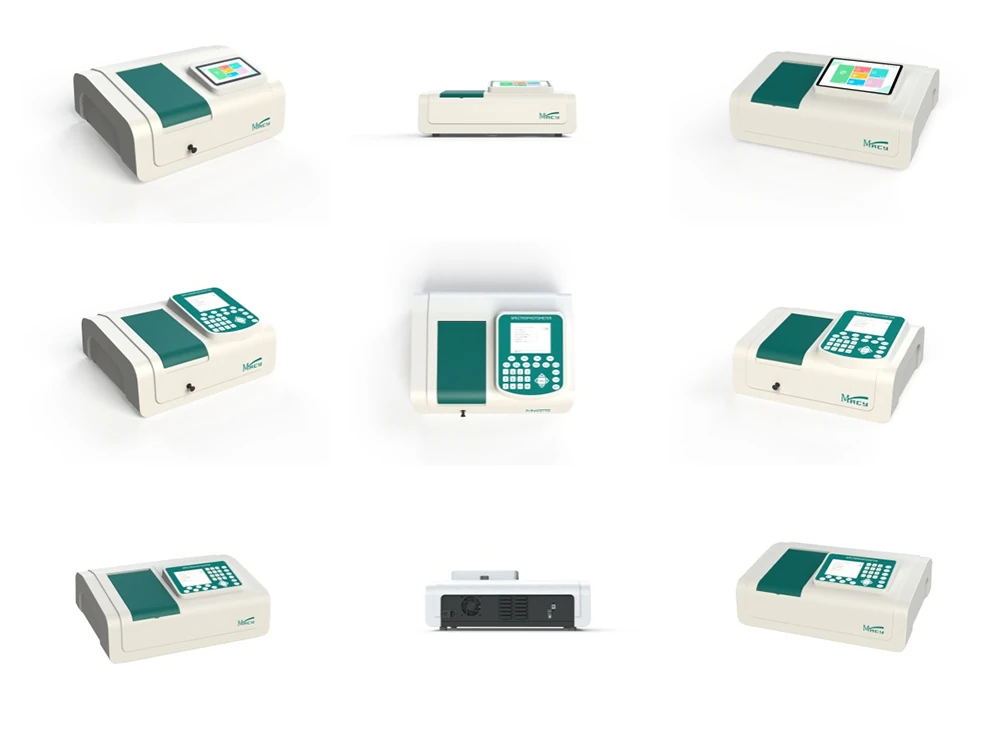
Volumetric flasks (single-line): 25 mL, 100 mL, 250 mL; Ultraviolet spectrophotometer; Magnetic stirrer; Membrane filter; Soxhlet extractor; Rotary vacuum evaporator; Water bath; Sample sieve; Analytical balance (5.9 – note: original text ambiguous digit retained as written).
6 Sampling
Laboratory samples shall be representative. See relevant detailed provisions for reference.
7 Sample Preparation
7.1 Ground Chilli
7.1.1 All powdered samples shall pass through a 500 μm aperture sieve. If not, grind the sample to meet the particle size requirement in accordance with ISO 2825, then homogenize thoroughly.
7.1.2 Weigh approximately 10 g of the homogenized powdered sample (7.1.1), accurate to 0.01 g, and transfer quantitatively into a Soxhlet extractor.
7.1.3 Extract with 100 mL tetrahydrofuran for 8 hours. Subsequently, transfer the extract into a 250 mL round-bottom flask and remove as much solvent as possible under reduced pressure on a rotary vacuum evaporator with a water bath.
7.1.2 Weigh approximately 10 g of the homogenized powdered sample (7.1.1), accurate to 0.01 g, and transfer quantitatively into a Soxhlet extractor.
7.1.3 Extract with 100 mL tetrahydrofuran for 8 hours. Subsequently, transfer the extract into a 250 mL round-bottom flask and remove as much solvent as possible under reduced pressure on a rotary vacuum evaporator with a water bath.
7.2 Whole Chillies
7.2.1 Grind whole chillies in accordance with ISO 2825, pass all ground material through a 500 μm aperture sieve, and homogenize thoroughly.
7.2.2 Weigh approximately 10 g of the homogenized ground sample, accurate to 0.01 g, and transfer quantitatively into a Soxhlet extractor.
7.2.3 Extract with 100 mL tetrahydrofuran for 8 hours. Transfer the resulting extract to a 250 mL round-bottom flask and concentrate under reduced pressure using a rotary vacuum evaporator with a water bath to remove solvent as completely as possible.
7.2.2 Weigh approximately 10 g of the homogenized ground sample, accurate to 0.01 g, and transfer quantitatively into a Soxhlet extractor.
7.2.3 Extract with 100 mL tetrahydrofuran for 8 hours. Transfer the resulting extract to a 250 mL round-bottom flask and concentrate under reduced pressure using a rotary vacuum evaporator with a water bath to remove solvent as completely as possible.
7.3 Chilli Oleoresin
7.3.1 Homogenize the chilli oleoresin completely.
7.3.2 Weigh 0.5 g to 1 g of the homogenized chilli oleoresin (7.3.1), accurate to 0.0001 g, and transfer into a 250 mL volumetric flask.
7.3.2 Weigh 0.5 g to 1 g of the homogenized chilli oleoresin (7.3.1), accurate to 0.0001 g, and transfer into a 250 mL volumetric flask.
8 Analytical Procedure
8.1 Preparation of Test Sample Solution
8.1.1 Ground Chilli and Whole Chillies
Add 0.058 g to 0.1 g activated carbon to the extract obtained in 7.1.3 or 7.2.3 (mass ratio of activated carbon to extract = 1:10). Add approximately 90 mL methanolic solution, magnetically stir for 30 minutes, and allow to stand for 5 minutes. Filter through a membrane filter into a
100 mL volumetric flask, dilute to mark with methanolic solution (Clause 4.3). The filtrate shall be clear (slight pale yellow colour does not interfere with measurement).
Add 0.058 g to 0.1 g activated carbon to the extract obtained in 7.1.3 or 7.2.3 (mass ratio of activated carbon to extract = 1:10). Add approximately 90 mL methanolic solution, magnetically stir for 30 minutes, and allow to stand for 5 minutes. Filter through a membrane filter into a
100 mL volumetric flask, dilute to mark with methanolic solution (Clause 4.3). The filtrate shall be clear (slight pale yellow colour does not interfere with measurement).
8.1.2 Chilli Oleoresin
Add 0.05 g to 0.1 g activated carbon to the sample (7.3.2) (mass ratio of activated carbon to oleoresin = 1:10). Add approximately 90 mL methanolic solution, magnetically stir for 30 minutes, and allow to stand for 5 minutes. Filter through a membrane filter into a 100 mL volumetric flask, dilute to mark with methanolic solution. The filtrate shall be clear (slight pale yellow colour does not interfere with measurement).
Add 0.05 g to 0.1 g activated carbon to the sample (7.3.2) (mass ratio of activated carbon to oleoresin = 1:10). Add approximately 90 mL methanolic solution, magnetically stir for 30 minutes, and allow to stand for 5 minutes. Filter through a membrane filter into a 100 mL volumetric flask, dilute to mark with methanolic solution. The filtrate shall be clear (slight pale yellow colour does not interfere with measurement).
8.2 Preparation of Dilutions for Photometric Measurement
8.2.1 Transfer 3 mL water and 2 mL hydrochloric acid solution into a 25 mL volumetric flask; dilute to mark with methanol. Label this solution as “Blank Acid Solution A”.
8.2.2 Transfer 3 mL water and 2 mL sodium hydroxide solution into a 25 mL volumetric flask; dilute to mark with methanol. Label this solution as “Blank Alkaline Solution B”.
8.2.3 Take three 25 mL volumetric flasks, labelled a1, a2, a3 respectively. Add 1 mL filtrate (8.1.1 or 8.1.2), 2.7 mL water and 2 mL hydrochloric acid solution to each flask, then dilute to mark with methanol.
8.2.4 Take another three 25 mL volumetric flasks, labelled b1, b2, b3 respectively. Add 1 mL filtrate (8.1.1 or 8.1.2), 2.7 mL water and 2 mL sodium hydroxide solution to each flask, then dilute to mark with methanol.
8.2.2 Transfer 3 mL water and 2 mL sodium hydroxide solution into a 25 mL volumetric flask; dilute to mark with methanol. Label this solution as “Blank Alkaline Solution B”.
8.2.3 Take three 25 mL volumetric flasks, labelled a1, a2, a3 respectively. Add 1 mL filtrate (8.1.1 or 8.1.2), 2.7 mL water and 2 mL hydrochloric acid solution to each flask, then dilute to mark with methanol.
8.2.4 Take another three 25 mL volumetric flasks, labelled b1, b2, b3 respectively. Add 1 mL filtrate (8.1.1 or 8.1.2), 2.7 mL water and 2 mL sodium hydroxide solution to each flask, then dilute to mark with methanol.
8.3 Spectrophotometric Measurement
8.3.1 Double-beam Spectrophotometer
Set zero absorbance and 100% transmittance using methanolic solution. Measure the absorbance of Blank Alkaline Solution B at 248 nm and 296 nm with Blank Acid Solution A as reference. Subsequently, measure the absorbance values of b1, b2, b3 at 248 nm and 296 nm, using the corresponding a1, a2, a3 as reference solutions respectively.
Set zero absorbance and 100% transmittance using methanolic solution. Measure the absorbance of Blank Alkaline Solution B at 248 nm and 296 nm with Blank Acid Solution A as reference. Subsequently, measure the absorbance values of b1, b2, b3 at 248 nm and 296 nm, using the corresponding a1, a2, a3 as reference solutions respectively.
8.3.2 Single-beam Spectrophotometer
Set zero absorbance and 100% transmittance using methanolic solution. Place Blank Alkaline Solution B in the measuring cell and re-zero the instrument; measure absorbance values of a1, a2, a3 at 248 nm and 296 nm respectively. Then place Blank Acid Solution A in the measuring cell and re-zero the instrument; measure absorbance values of b1, b2, b3 at 248 nm and 296 nm respectively.
Set zero absorbance and 100% transmittance using methanolic solution. Place Blank Alkaline Solution B in the measuring cell and re-zero the instrument; measure absorbance values of a1, a2, a3 at 248 nm and 296 nm respectively. Then place Blank Acid Solution A in the measuring cell and re-zero the instrument; measure absorbance values of b1, b2, b3 at 248 nm and 296 nm respectively.
9 Calculation
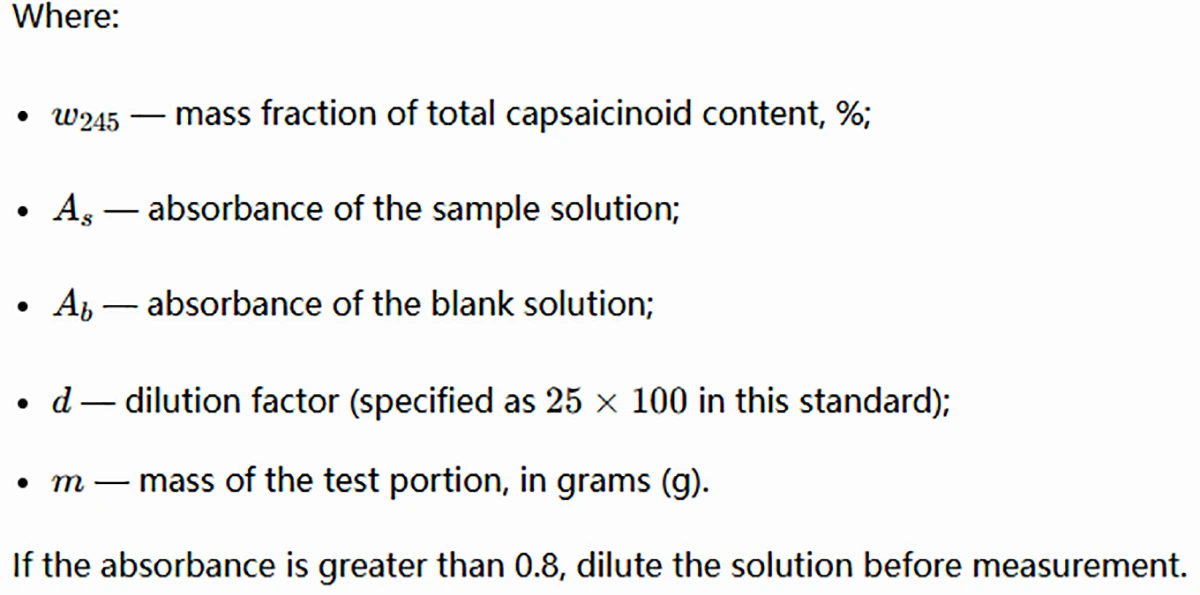
9.1 The mass fraction of total capsaicin content at 248 nm shall be calculated using the formula.
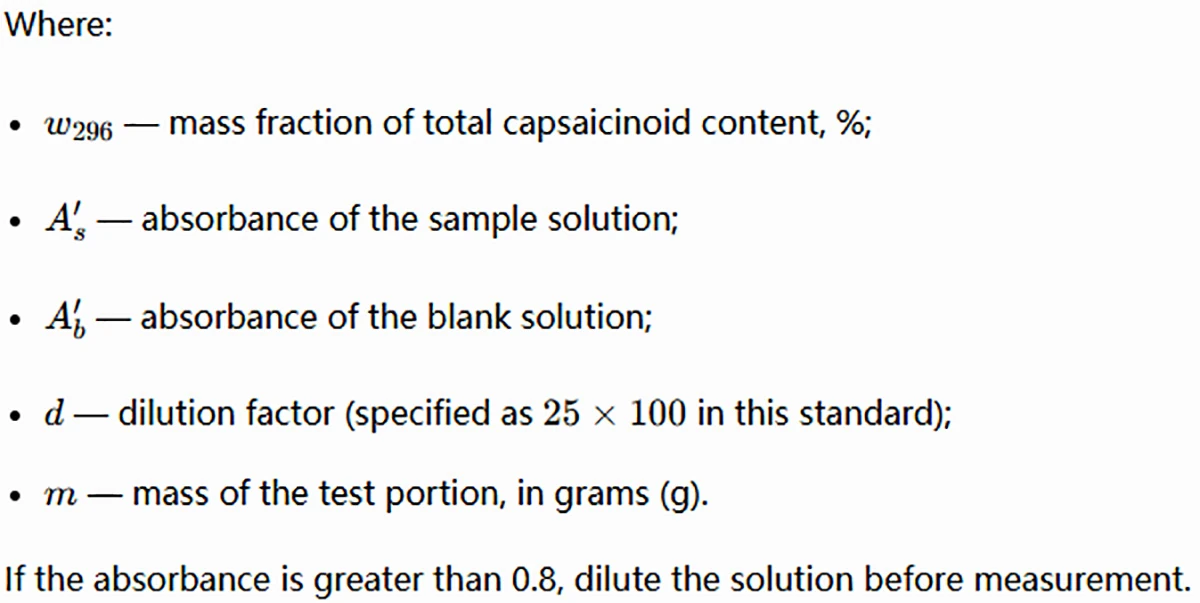
9.2 The mass fraction of total capsaicin content at 296 nm shall be calculated using the formula.
9.3 The relative difference between total capsaicin contents determined at 248 nm and 296 nm shall not exceed 10%; otherwise, repeat the test.
Method Source: GB/T 30389-2013
Method Source: GB/T 30389-2013
10 About Us
Macylab Instrument Co., Ltd. (hereinafter referred to as Macylab) is a high-tech enterprise with independent intellectual property rights. The company’s founding philosophy,’ Technology —— Change for You,’ guides its mission to continuously explore and innovate boldly. In the field of analytical testing instruments, Meixi consistently develops advanced products, positioning itself as a supplier of high-quality instruments.
Macylab specializes in a wide range of spectrometric instruments, including visible spectrophotometers, UV-visible spectrophotometers, atomic absorption spectrometers, ultra-micro spectrophotometers, atomic fluorescence spectrometers, ICP (inductively coupled plasma) emission spectrometers, and ICP-MS (inductively coupled plasma mass spectrometers). Our products are widely used in fields such as organic chemistry, inorganic chemistry, biochemistry, pharmaceuticals, environmental protection, metallurgy, petroleum, and agriculture. Leveraging our extensive experience in product mechanical design, optical design, electrical applications, and software development, and by aligning with the latest market demands, we will soon introduce a series of new analytical instruments.
Macylab specializes in a wide range of spectrometric instruments, including visible spectrophotometers, UV-visible spectrophotometers, atomic absorption spectrometers, ultra-micro spectrophotometers, atomic fluorescence spectrometers, ICP (inductively coupled plasma) emission spectrometers, and ICP-MS (inductively coupled plasma mass spectrometers). Our products are widely used in fields such as organic chemistry, inorganic chemistry, biochemistry, pharmaceuticals, environmental protection, metallurgy, petroleum, and agriculture. Leveraging our extensive experience in product mechanical design, optical design, electrical applications, and software development, and by aligning with the latest market demands, we will soon introduce a series of new analytical instruments.

Ready to Implement This Solution?
Contact our application specialists for a customized quote and method validation.