
Abstract
To establish a rapid analytical method for the quantification of soy isoflavones in food, genistein (the active component in soybean) was adopted as the reference standard. The content of soy isoflavone samples extracted via macroporous resin purification combined with solvent extraction was determined at the maximum UV absorption wavelength of genistein (259 nm). The total isoflavone content of the sample, calculated on the basis of genistein, was 38.7%. The average sample recovery rate was 99.86% with a relative standard deviation (RSD) of 2.6%. This method is simple and exhibits favorable reproducibility, which can be applied for the quantitative detection of soy isoflavones.
1 Materials and Methods
1.1 Instruments and Reagents
UV-Vis spectrophotometer; genistein reference standard (purity ≥ 99.999%); 95% ethanol (analytical grade, AR).
Test Sample
Soy isoflavone extract purified by macroporous adsorption resin; light yellowish-brown powder with a bitter taste.
Preparation of Standard Solution
Accurately weigh 5.2 mg of genistein standard, transfer into a 25 mL volumetric flask, dissolve with 95% ethanol and dilute to the mark, then shake well.
Preparation of Test Sample Solution
Accurately weigh 10.4 mg of purified soy isoflavone sample, transfer into a 50 mL volumetric flask, dissolve with 95% ethanol and dilute to the mark, then shake well.
Test Sample
Soy isoflavone extract purified by macroporous adsorption resin; light yellowish-brown powder with a bitter taste.
Preparation of Standard Solution
Accurately weigh 5.2 mg of genistein standard, transfer into a 25 mL volumetric flask, dissolve with 95% ethanol and dilute to the mark, then shake well.
Preparation of Test Sample Solution
Accurately weigh 10.4 mg of purified soy isoflavone sample, transfer into a 50 mL volumetric flask, dissolve with 95% ethanol and dilute to the mark, then shake well.
1.2 UV Absorption Scanning of Standard and Test Solutions
The absorption spectra of standard and sample solutions were scanned within 200–400 nm on the spectrophotometer. The results showed that both the standard and the sample possessed the maximum absorption peak at 259 nm with minimal interference around this wavelength.
1.3 Preparation of Calibration Curve
Precisely pipette 0.05, 0.10, 0.15, 0.20, 0.30 and 0.40 mL of standard solution into separate 10 mL volumetric flasks respectively. Add 1.0 mL of 95% ethanol to each flask, then dilute with distilled water to the mark and shake evenly. A blank control was prepared by mixing 1 mL of 95% ethanol with distilled water to a total volume of 10 mL. Absorbance was measured at 259 nm, and the calibration curve was plotted based on absorbance versus standard mass (Table 1).
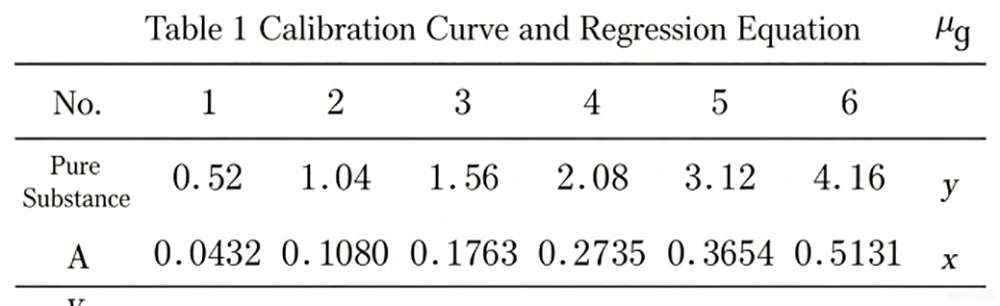
Regression equation: y =0.2006 + 7.8118x, correlation coefficient r =0.9996
1.4 Determination of Total Soy Isoflavones in Samples
Accurately transfer 0.3 mL of sample solution into three separate 10 mL volumetric flasks, and operate following the procedures described for calibration curve preparation. Measure the absorbance at 259 nm, calculate the average value, substitute into the calibration equation to obtain the content, and further compute the mass percentage of soy isoflavones in the sample (Table 2).
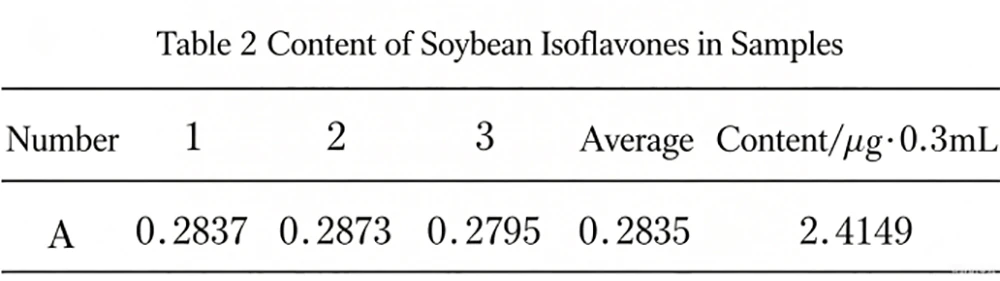
The mass percentage of total soy isoflavones in the sample (calculated as genistein) is 38.7%.
2 Results
Precision Test
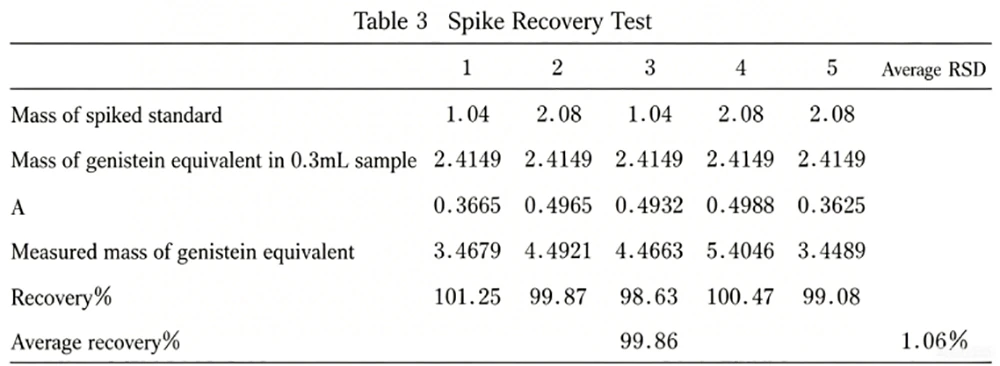
Accurately pipette 0.2 mL standard solution into five 10 mL volumetric flasks, operate according to the calibration curve procedure and measure absorbance. The RSD was 2.6%.
Recovery Test
Accurately pipette 0.1, 0.2, 0.1, 0.2 and 0.2 mL standard solutions into five separate 10 mL volumetric flasks, then add 0.3 mL sample solution to each flask precisely. Follow the calibration curve preparation steps to calculate the sample recovery rate (Table 3).
3 Discussion
Genistein, namely 5,7,4-trihydroxyisoflavone, contains multiple conjugated structures, which theoretically endows it UV absorption capacity. The measurement confirmed its maximum absorption at 259 nm. The sample solution showed its maximum absorption at the identical wavelength as the standard substance, so 259 nm was selected as the detection wavelength for quantification.
This detection method was modified based on the assay method for isoflavones in Puerariae Radix and its preparations specified under the monograph of Puerariae Radix in Volume I of the 1995 Edition of Chinese Pharmacopoeia. Both Puerariae Radix and soybean belong to Fabaceae family, and their flavonoid components are categorized as isoflavones with similar chemical structures. Puerariae Radix contains daidzein, glycitein and daidzin, which are also present in soybean. Therefore, UV spectrophotometry referenced from the detection method of Puerariae Radix isoflavones was adopted to quantify soy isoflavones. This method is simple and rapid, suitable for quality control and quantitative testing of all health foods and health medicines containing soy isoflavones.
For solid health food samples, refer to reported literature: dry the sample via low-temperature vacuum drying or freeze-drying, accurately weigh a certain amount of dried powder, place it in a Soxhlet extractor and perform reflux extraction with methanol. Concentrate and dry the extract, then dissolve and dilute to volume with 95% ethanol for measurement.
This detection method was modified based on the assay method for isoflavones in Puerariae Radix and its preparations specified under the monograph of Puerariae Radix in Volume I of the 1995 Edition of Chinese Pharmacopoeia. Both Puerariae Radix and soybean belong to Fabaceae family, and their flavonoid components are categorized as isoflavones with similar chemical structures. Puerariae Radix contains daidzein, glycitein and daidzin, which are also present in soybean. Therefore, UV spectrophotometry referenced from the detection method of Puerariae Radix isoflavones was adopted to quantify soy isoflavones. This method is simple and rapid, suitable for quality control and quantitative testing of all health foods and health medicines containing soy isoflavones.
For solid health food samples, refer to reported literature: dry the sample via low-temperature vacuum drying or freeze-drying, accurately weigh a certain amount of dried powder, place it in a Soxhlet extractor and perform reflux extraction with methanol. Concentrate and dry the extract, then dissolve and dilute to volume with 95% ethanol for measurement.
4 Instrument Parameters
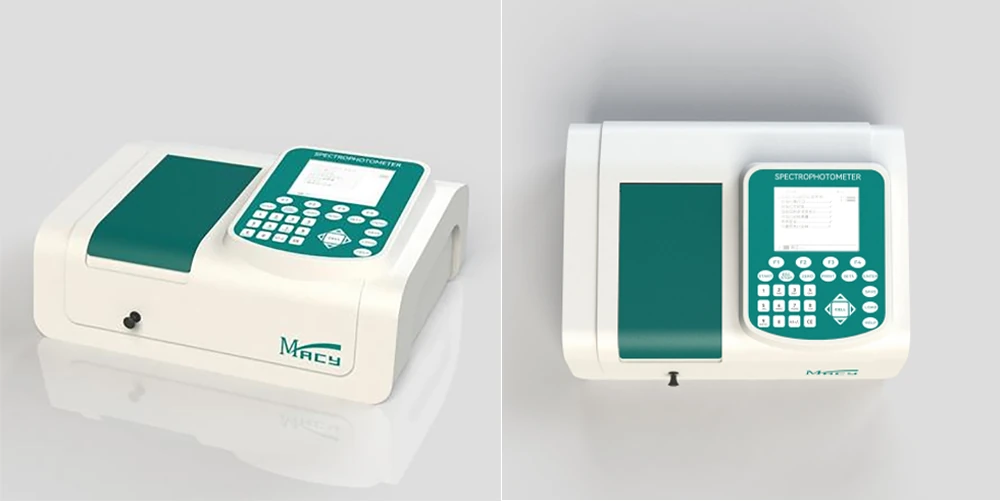
Product Description, Technical Parameters and Configuration
Instrument Features
· The UV-1600 meets strict requirements for high-precision and high-reliability measurement, applicable to diverse fields including biological research, bioindustry, pharmaceutical analysis, pharmaceutical manufacturing, teaching research, environmental protection, food hygiene, clinical testing and epidemic prevention.
· Wide wavelength range to satisfy the wavelength demands of various application scenarios.
· Large-scale integrated circuit design greatly improves system scalability and stability.
· Optimized optical path design, imported light source and detector deliver superior overall performance and reliability.
· Multiple measurement modes available: wavelength scan, time scan, multi-wavelength measurement, multi-order derivative measurement (optional), dual-wavelength measurement, triple-wavelength measurement (optional), DNA & protein quantification (optional). All test results can be directly displayed on a 6-inch large screen to meet diverse testing demands.
· Optional accessories upon customer request: single cell holder, manual four-cell holder, automatic eight-cell holder, film sample holder, test tube holder, 1 cm cuvette holder, 5 cm cuvette holder, etc.
· Measurement data can be printed out; equipped with USB interface.
· Automatically store measurement parameters and test data after power-off for user convenience.
· Compatible with PC control software to realize more accurate and flexible spectrum scanning and other measurement functions.
Instrument Features
· The UV-1600 meets strict requirements for high-precision and high-reliability measurement, applicable to diverse fields including biological research, bioindustry, pharmaceutical analysis, pharmaceutical manufacturing, teaching research, environmental protection, food hygiene, clinical testing and epidemic prevention.
· Wide wavelength range to satisfy the wavelength demands of various application scenarios.
· Large-scale integrated circuit design greatly improves system scalability and stability.
· Optimized optical path design, imported light source and detector deliver superior overall performance and reliability.
· Multiple measurement modes available: wavelength scan, time scan, multi-wavelength measurement, multi-order derivative measurement (optional), dual-wavelength measurement, triple-wavelength measurement (optional), DNA & protein quantification (optional). All test results can be directly displayed on a 6-inch large screen to meet diverse testing demands.
· Optional accessories upon customer request: single cell holder, manual four-cell holder, automatic eight-cell holder, film sample holder, test tube holder, 1 cm cuvette holder, 5 cm cuvette holder, etc.
· Measurement data can be printed out; equipped with USB interface.
· Automatically store measurement parameters and test data after power-off for user convenience.
· Compatible with PC control software to realize more accurate and flexible spectrum scanning and other measurement functions.
Ready to Implement This Solution?
Contact our application specialists for a customized quote and method validation.