Mastering Trace Metal Analysis: A 3-Tier Guide to the AA-1800H Atomic Absorption Spectrophotometer
The Strategic Landscape of Modern Elemental Analysis
1.The Global Demand for Heavy Metal Testing
In the modern analytical laboratory, the detection of trace elements is no longer a luxury but a necessity. From monitoring heavy metal contamination in drinking water to ensuring the safety of pharmaceutical excipients, the demand for precise, reliable, and high-throughput analysis has never been higher. Regulators such as the Environmental Protection Agency (EPA), the European Pharmacopoeia and the Indian Food Safety and Standards Agency (FSSAI) have gradually reduced the allowable limits for toxic elements such as lead (Pb), cadmium (Cd) and arsenic (As).
The core of this analysis revolution lies in a main instrument: the atomic absorption spectrophotometer. According to the market analysis by Grand View Research 2024, the value of the global atomic absorption spectrum market will exceed 500 million US dollars in 2023, which is mainly driven by strict environmental monitoring regulations and the expansion of mining activities in developing economies.
(Source: Grand View Research – AAS Market)
2. Defining the Core Technology: Atomic Absorption Spectrophotometer
The working principle of an atomic absorption spectrophotometer is relatively simple: free ground-state atoms generated in the optical path can absorb light with a specific wavelength unique to each element. By quantifying the absorbed light, the instrument can calculate the exact concentration of the target metal in a sample.
However, the engineering technology required to achieve this goal is extremely complicated. The instrument must transform the liquid sample into an atomic cloud (atomization), let the light with a specific wavelength pass through the atomic cloud, and isolate the light from all other emitted light.
Advanced Optical Engineering: The 1800 lines/mm Grating
1. The Significance of High Dispersion
The core of any atomic absorption spectrophotometer is a monochromator. AA-1800H is equipped with a large area grating with a dispersion rate of 1800 lines/mm. This high groove density is very important because it spreads the spectrum wider and enables the instrument to isolate the analytical line from the adjacent spectral interferences. This is especially important in analyzing complex samples such as blood or soil, because overlapping spectral lines can lead to false positives.
2. Expert Insight: Stability and Coating
The optical system adopts a novel self-collimation design, which minimizes spherical aberration. To ensure maximum luminous flux, especially in the ultraviolet (UV) region (as low as 180 nm), all lenses are coated with quartz. This optical accuracy ensures a baseline stability of ≤ 0.002+/30min (static). Without this stability, the instrument would drift during a run, rendering long-term, unattended analysis impossible.
Graphite Furnace AAS: Innovation in Temperature Control
1. Problems with Traditional Systems
The traditional graphite furnace AAS systems often has temperature lag. Most instruments use thermocouples attached to the outer wall of the graphite tubes to estimate the temperature. However, the actual temperature inside the test tube where the sample is located may vary greatly, resulting in poor reproducibility and inaccurate atomization.
2. The AA-1800H Solution: Inner Wall Monitoring
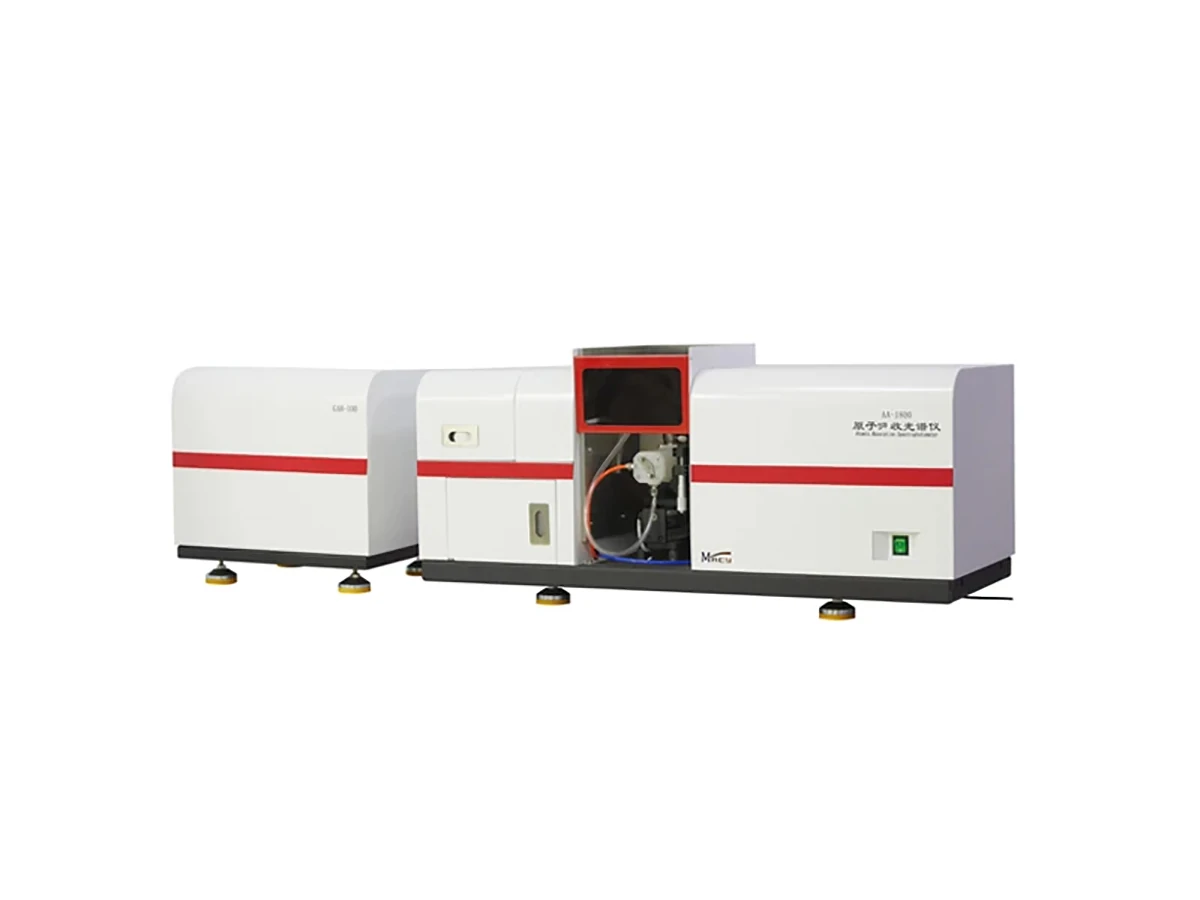
The AA-1800H atomic absorption spectrophotometer incorporates a patented vertical optical temperature monitoring system. Instead of guessing the temperature, the system directly observes the infrared radiation emitted from the inner wall of the graphite tube. This provides a real-time, accurate representation of the sample environment, ensuring that the atomization temperature is precisely controlled.
3. High-Temperature Detection
This precise control allows the furnace to reach temperatures up to 3000 ° C, making it capable of analyzing refractory elements such as Titanium (Ti), Vanadium (V), Molybdenum (Mo), and Barium (Ba). The system supports up to 20 steps of linear or nonlinear heating mode, ensuring that even the most challenging substrates can be thoroughly cleaned before atomization.
Hardware Durability & Specialized Materials
1. Polymer Spray Chamber
Chemical resistance is an important question in spectroscopy. The AA-1800H atomic absorption spectrophotometer features a Polymer Spray Chamber that is highly resistant to acids and alkalis, including hydrofluoric acid (HF). Unlike dissolved or corroded glass or metal sample chambers, the polymer material can ensure a long life and consistent performance in analyzing corrosive samples.
2. Titanium Burner
For flame analysis, the system uses 50mm and 100mm titanium burners. Titanium is selected because of its excellent corrosion resistance and high salt tolerance. This design greatly improves the efficiency and accuracy of the flame method, especially for environmental samples, such as seawater or saltwater.
3. Automation and Error Reduction
Manual replacement of the lamp is a common source of error. AA-1800H eliminates this point with a 6-lamp automatic turret. Each lamp has its own power supply and can be preheated at the same time. The system can automatically adjust the position of the light beam and perform wavelength scanning, reducing manual intervention and ensuring consistent results.
Core Technical Specifications
Compliance and Global Certifications
AA-1800H is not only a high-performance tool; It is a global compliance tool, which is suitable for the most strictly regulated industries.
- CE (European Conformity): Meets EU health, safety, and environmental protection standards.
- ETL (Intertek): Certified for North American safety standards.
- FCC (Federal Communications Commission): Ensures electromagnetic compatibility.
- RoHS (Restriction of Hazardous Substances): Compliant with environmental directives restricting toxic materials.
- CQC & 3C: Chinese quality and safety certifications for domestic and international trade.
These certifications ensure that the AA-1800H atomic absorption spectrophotometer is a reliable partner in the fields of pharmacy, environmental protection, metallurgy and food security.
Frequently Asked Questions (FAQ)
Q1: What is the difference between D2 and SR background correction in atomic absorption?
A: D2 (deuterium lamp) calibration is most suitable for simple substrates (such as water), which can correct broadband molecular absorption. SR (self-reversal) correction uses a high current pulse on the hollow cathode lamp itself. It is superior for complex substrates (such as food or soil) because it has a higher correction ability (> 50 fold) and has no “self-absorption” disadvantage of the D2 method for some elements.
Q2: How does the polymer spray chamber handle hydrofluoric acid?
A: Hydrofluoric acid (HF) aggressively dissolves glass and silica-based materials. The AA-1800H uses a specialized Polymer Spray Chamber made from chemically inert plastics that are completely immune to HF, allowing for the safe analysis of fluoride-containing samples or samples prepared with HF digestion.
Q3: What is the precision of the AA-1800H autosampler for graphite furnace AAS?
A: The autosampler is very accurate, providing a minimum sample volume of 0.5 µL in increments of 0.1 µL. Its analytical accuracy is better than 1% at volumes between 10 µL and 100 µL, ensuring excellent reproducibility for trace-level analysis.
Q4: How does the 1800 lines/mm grating affect the detection limit?
A: A higher density grating (1200 lines/mm compared with 1800 lines/mm) provides better spectral resolution. By isolating the analytical line from background noise and adjacent spectral lines more effectively, the instrument can obtain a clearer signal, which directly reduces the detection limit and improves the signal-to-noise ratio.
Conclusion: Why Choose the AA-1800H?
The AA-1800H strikes a perfect balance between innovative engineering and rugged reliability. By combining a cast aluminum optical pedestal, high dispersion 1800 line/mm grating and patented vertical optical temperature monitoring for graphite furnace AAS, Macylab has created an instrument which meets the strict requirements of modern science. Whether you are monitoring heavy metals in drinking water or analyzing precious metals in ores, the AA-1800H can provide you with the data integrity you need.