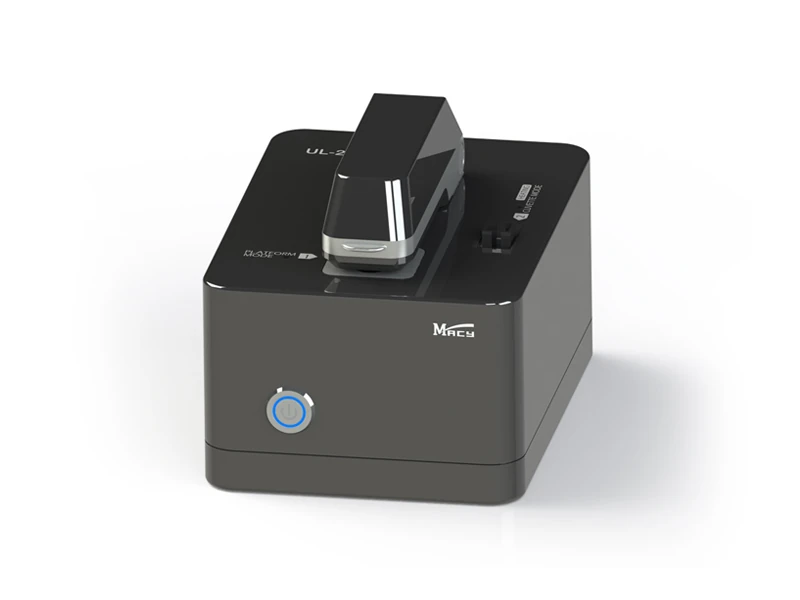
The Macylab UL-2000 is a compact, PC-controlled micro-volume UV-Vis spectrophotometer engineered for the quantitative and qualitative analysis of biological samples. Operating in the 190nm to 850nm wavelength range, it is primarily utilized for measuring nucleic acids, proteins, and bacterial concentrations.
Equipped with a long-life Xenon flash lamp and a 3648-pixel linear CCD array detector, the UL-2000 performs rapid analytical scans without the need for lamp warm-up time. It requires a minimum sample volume of just 0.5μL, allowing researchers to conserve precious samples while avoiding the manual dilution steps typically required by traditional cuvette-based spectrophotometers.
Key Features
Micro-Volume Analysis: Allows direct testing of highly concentrated samples with a minimum volume of 0.5μL. Most samples can be measured directly without prior dilution, reducing preparation errors and saving time.
Instant Testing (No Warm-Up): Utilizes a high-intensity Xenon flash lamp that flashes only during measurement. This eliminates the standard 15-minute warm-up time required by traditional deuterium/tungsten lamps and significantly extends the light source’s lifespan.
Wide Dynamic Range: Capable of measuring double-stranded DNA (dsDNA) concentrations ranging from a lower limit of 2 ng/μL up to an upper limit of 15,000 ng/μL, covering a broad spectrum of molecular biology applications.
Durable Sample Pedestal: The micro-volume measurement pedestal is constructed from 304 stainless steel and quartz, providing a robust, easy-to-clean surface that prevents sample cross-contamination.
Dual Measurement Modes: Supports both micro-volume drop testing via the adjustable optical path (1mm / 0.2mm / 0.05mm) and standard testing via a cuvette slot (up to 10mm optical path).
Compact & Portable Design: Weighing only ≤2.5kg with a footprint of 200 × 130 mm, the instrument is highly space-efficient and easily transportable for on-site testing environments.
Specifications
Parameter
Specification
Model
UL-2000
Minimum Sample Size
0.5 μL
Wavelength Range
190 – 850 nm
Wavelength Accuracy
1 nm
Wavelength Resolution
≤0.3 nm (FWHM at Hg 253.7nm)
Optical Distance (Micro-volume)
1mm / 0.2mm / 0.05mm (optional)
Optical Distance (Cuvette)
10mm / 5mm / 2mm / 1mm
Absorbance Range
0.005 – 300 A (10mm equivalent)
Absorbance Accuracy
2% (0.76 at 257nm)
Absorbance Resolution
0.002 Abs (at 1mm optical distance)
Detection Range (dsDNA)
Lower limit: 2 ng/μL | Upper limit: 15,000 ng/μL
Protein Measurement Range
0.1 – 100 mg/mL
Measurement Time
< 5 Seconds
Light Source
Xenon flash lamp
Detector
3648-pixel linear CCD array
Sample Pedestal Material
304 Stainless Steel and Quartz
Control System
PC Control (Data via USB)
Power & Voltage
24W | AC100-240V; 50-60Hz
Dimensions (W x D x H)
200 × 130 × 136 mm
Weight
≤2.5 KG
Applications
The UL-2000 is utilized in life sciences, clinical research, and industrial biotechnology for routine quantitative testing:
Nucleic Acid Quantification: Rapid concentration and purity measurements of dsDNA, ssDNA, and RNA (e.g., A260/A280, A260/A230 ratios) for downstream applications like PCR and sequencing.
Protein Analysis: Direct protein concentration measurements (A280) and colorimetric protein assays (such as BCA, Bradford, and Lowry methods).
Cell Culture Monitoring: Measuring bacterial cell density (OD600) utilizing the standard cuvette testing mode.
General UV-Vis Spectrophotometry: Full-spectrum scanning from 190nm to 850nm for varied biochemical liquid samples.
Who is it for?
Molecular Biology Laboratories: University and research institute labs that handle precious nucleic acid and protein extracts requiring minimal sample waste.
Clinical and Medical Research: Testing facilities conducting genetics, genomics, and proteomics research that require fast, reliable concentration readouts.
Biotech and Pharmaceutical QC: Quality control departments needing a compact, durable instrument for daily consumption tests and batch validation.
Why choose it?
Workflow Efficiency: By requiring only 0.5μL of the sample and measuring it in under 5 seconds without warm-up or dilution, the UL-2000 significantly accelerates daily laboratory workflows compared to standard cuvette-based spectrophotometers.
Flexible Measurement Platform: The instrument’s ability to switch between micro-volume pedestal testing and standard cuvette testing ensures it can handle both highly concentrated biological extracts and standard diluted solutions.
Certified Quality: The instrument complies with major international product qualifications and electrical safety standards, holding certifications including the European CE mark, North American ETL, FCC, RoHS, China CQC, and 3C.
Packaging, Installation & Operation
Packaging & Shipping
After unpacking the instrument, compare the contents with the packing list and check that all items are present and undamaged.
Installation & Setup
Place the spectrophotometer in a suitable location away from direct sunlight, dust, corrosive gases, and strong vibrations. For stable operation, keep it away from strong magnetic or electrical fields and electrical devices that may generate high-frequency fields.
Keep the area around and underneath the instrument clear to allow adequate airflow.
Use the appropriate power cord and connect the instrument to a grounded outlet.
Initial Operation
Turn on the spectrophotometer and allow it to warm up for the recommended time before taking measurements. Follow the instrument’s operating instructions to complete any required system initialization, calibration, or wavelength verification before measurement.
Exhibition
FAQ (Frequently Asked Questions)
No. Unlike traditional spectrophotometers that use deuterium or tungsten lamps requiring a 15-minute warm-up, the UL-2000 is equipped with a Xenon flash lamp. It is ready to test immediately upon powering on.
For most applications, dilution is not required. The UL-2000 features a wide dynamic absorbance range (0.005 – 300A, 10mm equivalent) and can directly measure dsDNA concentrations up to 15,000 ng/μL using its adjustable micro-volume optical path.
The sample pedestal is made of 304 stainless steel and quartz. You can easily clean it by simply wiping the upper and lower optical surfaces with a clean, dry, lint-free laboratory wipe between sample measurements to prevent cross-contamination.
Yes. Alongside the micro-volume pedestal, the instrument supports cuvette optical distances of 10mm, 5mm, 2mm, and 1mm, allowing for traditional cell culture density (OD600) and dilute sample measurements.
Yes. The UL-2000 relies on a PC connection for operation. The instrument connects via a data line, and the provided software interface on your computer controls the scanning process, data analysis, and report generation.