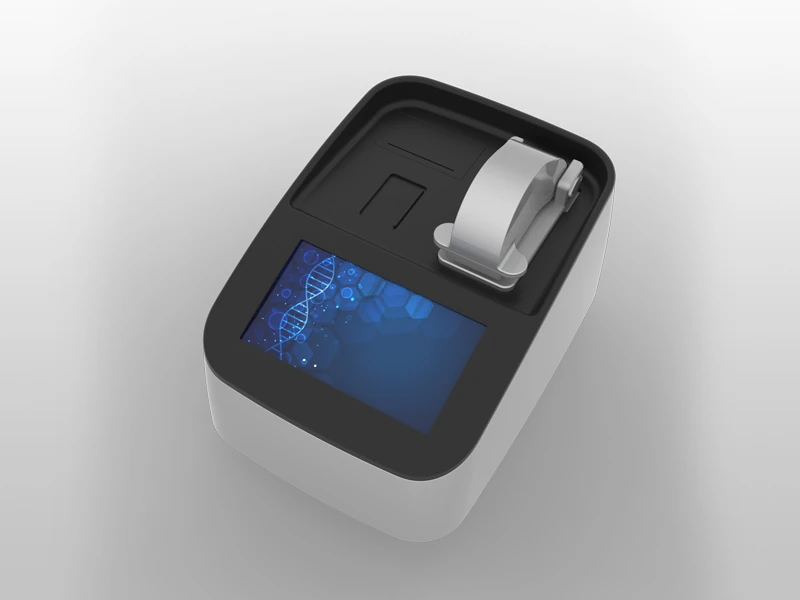
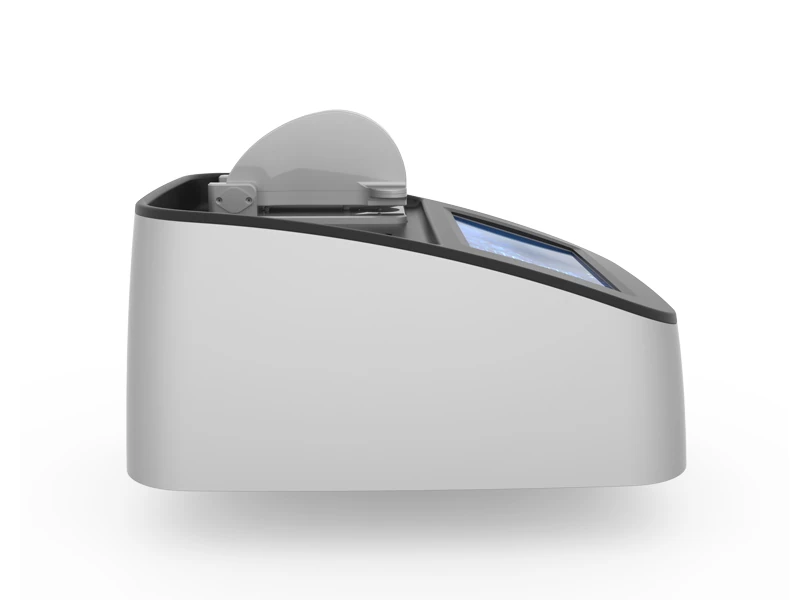
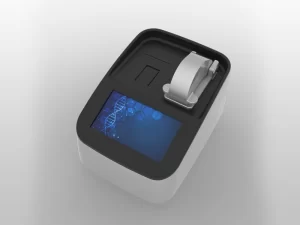
The Macylab UL-5000 is a full-wavelength ultra-micro spectrophotometer designed for quantitative and qualitative analysis in molecular biology and biochemical laboratories. Operating in the 190nm to 900nm wavelength range, it features two distinct detection modes: a micro-volume base station mode and a standard cuvette mode.
Equipped with a customized Android operating system and a 7-inch capacitive touchscreen, the instrument functions completely independently without requiring an external computer. Utilizing a long-life Xenon flash lamp and a UV-enhanced CMOS linear array sensor, the UL-5000 provides rapid detection of nucleic acids, proteins, and cell solutions using a minimum sample volume of just 0.3μL.
Key Features
Dual Detection Modes (2-in-1): Combines a micro-volume measurement pedestal with a standard cuvette slot. The cuvette mode supports OD600 detection for measuring the growth density of bacterial, yeast, and cell cultures.
Standalone Android System: Operates via an integrated 7-inch capacitive touchscreen running a customized Android OS. It requires no external PC, enabling direct data processing, storage, and intelligent testing.
Continuous Auto-Switching Path Length: The micro-volume optical distance (0.02–1mm) uses continuous exposure and automatic switching, allowing the instrument to measure a broad concentration range directly without manual dilution.
Broad Measurement Range: Capable of measuring double-stranded DNA (dsDNA) concentrations from 1.5 ng/μL up to 37,500 ng/μL without requiring sample dilution.
Rapid Testing (No Warm-Up): The Xenon flash lamp requires no standard warm-up period, completing scans in under 3 seconds. The lamp is designed for an operating life of up to 10 years (approximately 10⁹ flashes).
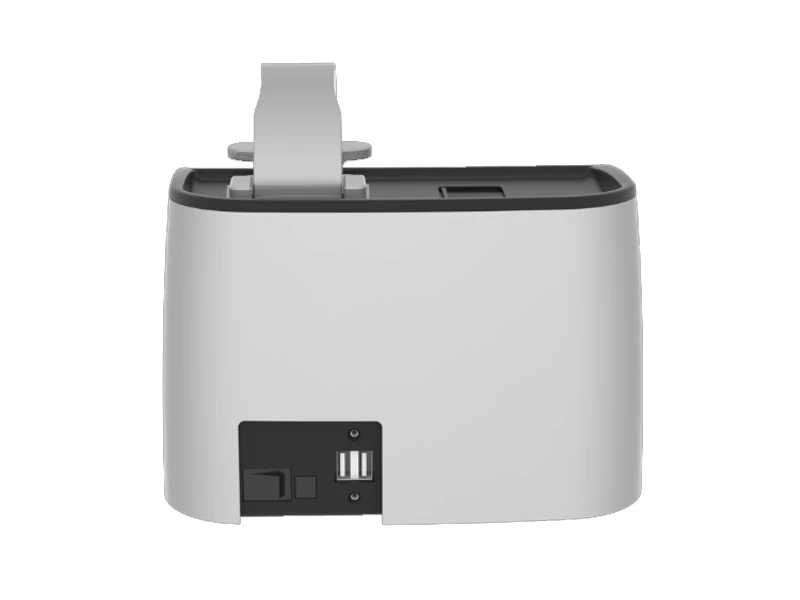
Onboard Storage & Printing: Features a built-in thermal printer for immediate report generation. The system can store approximately 100,000 detection records, which can be exported via a USB interface.
Fluorescence Detection Capability: Supports high-sensitivity fluorescence detection with a sensitivity of 0.5 pg/μL (dsDNA), linearity R² > 0.996, and repeatability < 1.5%.
Specifications
Parameter
Specification
Model
UL-5000
Minimum Sample Size
0.3 μL
Wavelength Range
190 – 900 nm
Optical Distance (Micro-volume)
0.02 – 1 mm (Continuous exposure, automatic switching)
Cuvette Optical Distance
10mm / 5mm / 2mm / 1mm
Wavelength Accuracy
1 nm
Wavelength Resolution
1 nm
Absorbance Accuracy
±1% (0.76 at 260nm)
Absorbance Resolution
0.002 Abs (at 1mm optical distance)
Absorbance Range
0 – 750 A (10mm equivalent)
OD600 Absorbance Range
0 – 4.000 Abs
OD600 Absorbance Stability
[0, 3) ≤0.5%, [3, 4) ≤2%
OD600 Absorbance Repeatability
[0, 3) ≤0.5%, [3, 4) ≤2%
Nucleic Acid Detection Range
1.5 – 37,500 ng/μL (dsDNA)
Protein Detection Range
0.05 – 1110 mg/mL (BSA) | 0.03 – 540 mg/mL (IgG)
Fluorescence Sensitivity
0.5 pg/μL (dsDNA)
Fluorescence Linearity / Repeatability
Linearity R² > 0.996 | Repeatability < 1.5%
Measurement Time
< 3 Seconds
Light Source
Xenon flash lamp (Life up to 10 years / 10⁹ flashes)
Detector
UV-enhanced CMOS linear array sensor
Display
7-inch touch screen (Android System)
Data Output & Storage
Built-in thermal printer | USB export | 100,000 records storage
Dimensions (W x D x H)
310 × 221 × 176 mm
Applications
The UL-5000 is utilized in life sciences, biotechnology, and clinical testing for routine analytical procedures:
Nucleic Acid Quantification: Fast concentration and purity checks for dsDNA, ssDNA, and RNA to prepare samples for downstream applications such as PCR, qPCR, and sequencing.
Protein Concentration Determination: Direct absorbance measurement across a wide dynamic range for proteins such as BSA and IgG.
Microbial Culture Monitoring: Utilizing the cuvette module for OD600 absorbance detection to monitor growth curves of bacterial liquids and yeast suspensions.
General UV-Vis Absorption Testing: Broad-spectrum routine absorbance analysis across 190nm to 900nm for biochemical solutions.
Who is it for?
Molecular Biology Laboratories: Research teams that work with micro-volume samples down to 0.3μL and need to minimize sample consumption.
Academic and Research Institutes: Labs requiring an all-in-one benchtop instrument that does not require an external PC workstation.
Biotechnology & Quality Control: QC departments that need immediate result printing via the integrated thermal printer and straightforward USB data export.
Why choose it?
Wide Dynamic Range: The automatic switching of the micro-volume optical path (0.02–1mm) allows the instrument to directly measure dsDNA up to 37,500 ng/μL, reducing manual dilution steps and dilution-related calculation errors.
Independent Operation: The integrated 7-inch touchscreen running a customized Android OS saves bench space by eliminating the requirement for a separate computer.
Rapid Workflow: Testing takes under 3 seconds per sample, and the Xenon flash lamp requires no warm-up period, allowing immediate testing upon powering on.
Certified Safety & Quality: The instrument complies with major international regulatory qualifications, holding CE, ETL, FCC, RoHS, CQC, and 3C certifications.
Packaging, Installation & Operation
Packaging & Shipping
After unpacking the instrument, compare the contents with the packing list and check that all items are present and undamaged.
Installation & Setup
Place the spectrophotometer in a suitable location away from direct sunlight, dust, corrosive gases, and strong vibrations. For stable operation, keep it away from strong magnetic or electrical fields and electrical devices that may generate high-frequency fields.
Keep the area around and underneath the instrument clear to allow adequate airflow.
Use the appropriate power cord and connect the instrument to a grounded outlet.
Initial Operation
Turn on the spectrophotometer and allow it to warm up for the recommended time before taking measurements. Follow the instrument’s operating instructions to complete any required system initialization, calibration, or wavelength verification before measurement.
Exhibition
FAQ (Frequently Asked Questions)
The micro-volume pedestal requires a minimum sample volume of 0.3μL. For optimal droplet formation and measurement consistency, a volume between 0.5μL and 2μL is recommended.
No. The UL-5000 is a fully standalone instrument equipped with a 7-inch capacitive touchscreen and an integrated Android operating system. All measurement controls, data analysis, and report printing can be handled directly on the device.
Yes. The UL-5000 includes a built-in thermal printer, enabling direct printing of test reports immediately following measurement. Data can also be saved to internal storage (up to 100,000 records) and exported to a USB flash drive.
No. Because the UL-5000 uses a pulsed Xenon flash lamp rather than a continuous deuterium or tungsten light source, it requires no warm-up period and can measure samples immediately after startup.
Yes. In addition to the micro-volume pedestal, the instrument includes a standard cuvette slot supporting optical distances of 10mm, 5mm, 2mm, and 1mm for OD600 cell density and culture monitoring.