Why Is the AA-1800EL Atomic Absorption Spectrophotometer the Ultimate Heavy Metal Detector for Cosmetic Safety Compliance?
Introduction
In an era where consumers scrutinize cosmetic ingredient labels with increasing vigilance, the global cosmetics industry faces unprecedented pressure to ensure product safety. The presence of heavy metals—particularly lead (Pb), cadmium (Cd), arsenic (As), and mercury (Hg)—in skincare and makeup products is no longer a fringe concern, but a critical issue of regulatory compliance. From the U.S. Food and Drug Administration (FDA) to the European Chemicals Agency (ECHA), regulatory bodies worldwide have established stringent limits for elemental impurities. For laboratories and manufacturers, the challenge lies not only in detecting these contaminants, but also in how to perform the detection task accurately, quickly, and reliably in complex cosmetic matrices such as pigments, oils, and emulsifiers.
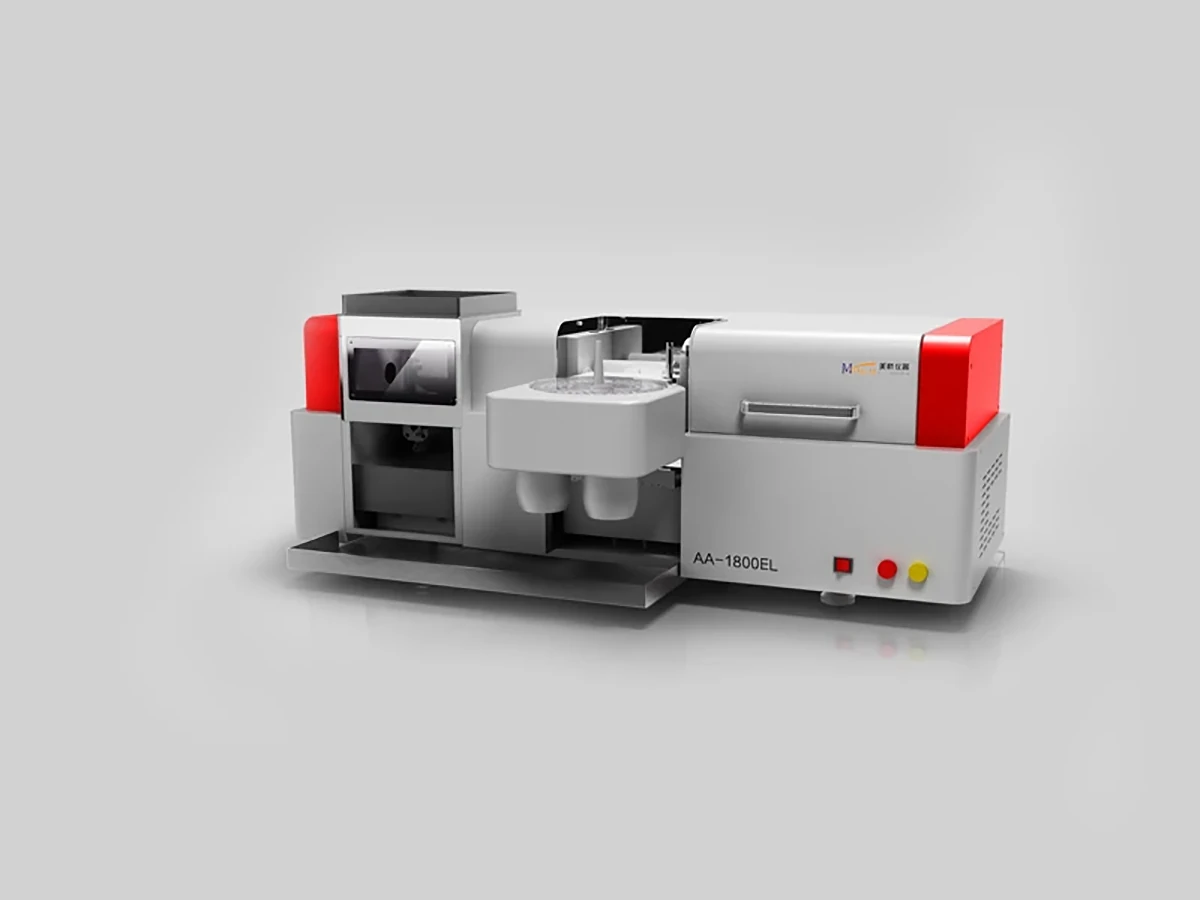
This article will provide an in-depth technical analysis, explaining why the AA-1800EL atomic absorption spectrophotometer, jointly developed by Macy Lab and several leading research institutions, has become the ultimate solution for modern cosmetic quality control laboratories. We will explore the instrument’s technical specifications, its unique advantages in handling complex samples, and why its design philosophy is perfectly aligned with international standards such as ISO 21392.
The Growing Imperative for Precision in Cosmetic Heavy Metal Analysis
Heavy metals naturally occur in the environment, often finding their way into cosmetic raw materials through soil contamination or industrial processing. However, their accumulation in the human body can lead to severe toxicological effects, including neurotoxicity, organ damage, and carcinogenic risks.
Cosmetics are complex samples — oils, pigments, and emulsifiers create matrix interference that causes false readings in conventional heavy metal detector systems. Labs need instrumentation that quantifies toxins at ppb levels without being thrown off by the matrix.
A 2026 study in MDPI’s Toxics journal makes the stakes clear. Researchers have tested 189 cosmetic products across seven Asian countries. Mercury in face creams hit a median of 2,952 mg/kg, with Philippine samples peaking at 67,000 mg/kg. Those numbers demand analytical tools with a wide dynamic range that deliver accurate results, not measurement artifacts.(Source: https://www.mdpi.com/2305-6304/14/2/167)
Technical Deep Dive: The AA-1800EL Specifications
To understand why the AA-1800EL stands out, one must examine its core engineering. Unlike single-beam systems that are susceptible to drift due to fluctuations in the light source or detector sensitivity, the AA-1800EL utilizes a sophisticated atomic absorption spectrophotometer double beam architecture. This design splits the light path, sending one beam through the sample and the other as a reference. By continuously comparing the two, the instrument compensates for any source intensity variations, ensuring exceptional baseline stability (≤±0.002A/30 min static).
Key Feature Technical Specification
| Optical System | Large 1800 lines/mm grating, atomic absorption spectrophotometer double beam, fully enclosed |
| Wavelength Range | 185nm – 900nm (Auto peak search) |
| Lamp System | ≤8 Lamp Automatic Turret (Supports hollow cathode lamp) |
| Flame Detection Limit (Cu) | 0.002 μg/mL |
| Graphite Furnace Detection Limit (Cd) | 0.4 × 10⁻¹² g |
| Burner | Full Titanium Burner (50mm/100mm options), corrosion-resistant |
| Spray Chamber | Polymer material, acid/alkali/hydrofluoric acid resistant |
| Safety Certifications | CE, ETL, FCC, RoHS, CQC, CCC |
Application Focus: Mastering Complex Cosmetic Matrices
The chemical composition of cosmetic products is highly complex. Even a simple moisturizer contains a variety of ingredients such as oils, waxes, preservatives, and fragrances. To perform heavy metal analysis on these components, a sophisticated instrument capable of handling various physical and chemical properties is required.
1. Trace Analysis Using Graphite Furnace Atomic Absorption Spectrometry (AAS)
For elements such as cadmium (Cd) and lead (Pb)—which exhibit toxicity even at extremely low concentrations—the Graphite Furnace AAS mode of the AA-1800EL instrument serves as an essential analytical tool. While flame AAS mode is suitable for analyzing samples with higher concentrations, graphite furnace AAS mode allows for the direct introduction of trace amounts of sample (typically 5-50 μL) and the separation of analytes from the matrix through a multi-stage heating process, including drying, ashing, and atomization.
The AA-1800EL’s unique vertical heating system ensures uniform temperature distribution inside the graphite tube. With its characteristic sensitivity index of cadmium down to 0.4 × 10⁻¹² g, this instrument fully complies with the most stringent international standards for trace metal detection. For cosmetic testing laboratories, this means being able to detect contaminants that other instruments might miss, thus providing an extra layer of protection for consumer safety.
2. Overcoming Matrix Interference Challenges
One of the most significant challenges in the field of cosmetic testing is the issue of “background absorption.” Certain ingredients in cosmetics (such as pearlescent agents) may scatter light or produce non-specific absorption, leading to falsely high test readings. The AA-1800EL effectively solves this problem with advanced background correction technology (deuterium lamp), supported by a dual-beam optical system for baseline stability. The instrument compares the sample beam with a continuous light source to efficiently remove background noise and outputs a pure analytical signal that represents only the true concentration of the heavy metal being measured.
3. Flexible and Versatile Sample Introduction Methods
The application scope of the AA-1800EL instrument extends far beyond the analysis of liquid samples alone. Its titanium alloy burner and high-performance polymer atomization chamber are specially designed to easily handle high-salt solutions and various organic solvents commonly used to dissolve stubborn cosmetic bases. Whether analyzing water-based toners or oil-based foundations, the system consistently maintains stable and efficient atomization performance.
FAQ
Q1: How does the AA-1800EL handle the high salt content often found in cosmetic preservatives?
A:The instrument is equipped with a specialized polymer spray chamber and a robust nebulizer designed to prevent clogging. Additionally, the atomic absorption spectrophotometer double beam system compensates for any signal drift caused by salt deposits on the burner, ensuring stable readings throughout the analysis run.
Q2: Can the AA-1800EL detect Mercury (Hg) effectively?
A:Yes. While Mercury is difficult to analyze via standard flame AAS due to its volatility, the AA-1800EL can be coupled with a cold vapor generation system or a dedicated graphite furnace AAS program optimized for volatile elements, achieving detection limits well below regulatory requirements.
Q3: Is the software user-friendly for new operators?
A:Absolutely. The software features an intuitive, icon-driven interface (English). It includes pre-set methods for common elements and a “one-click optimization” feature that shortens the learning curve for junior technicians while offering advanced customization for experts.
Q4: What certifications does the AA-1800EL carry?
A: The AA-1800EL holds CE (European safety), ETL (North American safety), FCC (electromagnetic compatibility), RoHS (environmental), CQC (China Quality), and 3C (China mandatory product) certifications. These certifications make it suitable for deployment in regulated laboratories across Europe, North America, and Asia.
Conclusion: Elevating Cosmetic Safety Standards
In the competitive cosmetics industry, brand reputation rests on safety. The AA-1800EL is not just an analytical instrument, but also a comprehensive quality assurance platform. It combines the high sensitivity of graphite furnace AAS, the robustness of its corrosion-resistant design, and the multifunctionality of multi-lamp hollow cathode lamp detection, completely solving all the pain points in the field of heavy metal analysis in cosmetics.
For laboratories that are committed to meeting the stringent requirements of global regulations and need to provide solid evidence to prove the safety of their products, the AA-1800EL provides the necessary accuracy, reliability, and efficiency to help them maintain their leading position in the industry.
If you are interested in the products offered by our instrument manufacturing company, please do not hesitate to contact us at any time to receive a customized solution and technical support.