How to Evaluate Graphite Furnace Atomic Absorption Spectrometer Performance for Trace Element Analysis?
Key Takeaways
When selecting a Graphite Furnace Atomic Absorption Spectrometer, price is certainly a factor to consider, but what’s even more important is its sensitivity, temperature control, background correction, and long-term stability.
This technology was originally developed to meet the demands of high sensitivity and small sample volumes in trace analysis, so these performance characteristics naturally take precedence in the evaluation.
The performance of a furnace system depends on multiple factors, including graphite tube design, interference control, automation functions, and application suitability.
Choosing the right graphite furnace atomic absorption spectrophotometer helps laboratories improve analytical confidence while maintaining efficient testing workflows.
Introduction
Trace element analysis has become increasingly important in environmental monitoring, food safety, pharmaceutical quality control, and industrial testing. Laboratories are often required to measure elements such as lead (Pb), cadmium (Cd), arsenic (As), and chromium (Cr) at very low concentrations while maintaining reliable and repeatable results.In these applications, a Heavy Metal Detector capability is often required to support accurate identification and quantification of target elements.
Although Atomic Absorption Spectrophotometers are widely used for elemental analysis, different atomization technologies serve different laboratory requirements. Flame-based systems are suitable for many routine applications, while furnace-based systems are designed for situations where higher sensitivity and lower sample consumption are required.
A Graphite Furnace Atomic Absorption Spectrometer uses electrothermal atomization technology to heat a small sample inside a graphite tube. The controlled heating process allows the analyte to remain in the optical path for a longer period, improving measurement sensitivity for trace elements.
Graphite furnace atomic absorption is commonly applied for trace metal determination because of its ability to achieve lower detection levels compared with traditional flame atomization methods. However, purchasing decisions should not focus only on sensitivity. Laboratory managers also need to consider interference control, operating costs, maintenance requirements, and workflow efficiency.
Key Performance Factors That Determine GFAAS Analytical Accuracy
Detection Sensitivity and Trace Element Capability
The main advantage of graphite furnace analysis is its ability to measure elements at very low concentrations using only a small sample volume. Unlike flame atomization, where samples are continuously introduced into a flame, furnace analysis uses a programmed heating process to convert the sample into free atoms.
The typical graphite furnace process includes three important stages: drying, ashing, and atomization. During drying, solvents are removed from the sample. The ashing stage eliminates part of the sample matrix, while atomization rapidly heats the graphite tube to release atoms for absorption measurement.
According to NOAA technical documentation, graphite furnace atomic absorption methods are frequently used for trace metal analysis where laboratories require improved sensitivity and precise determination of low-level elements.
When evaluating a graphite furnace atomic absorption spectrophotometer, laboratories should consider whether the instrument matches their actual analytical requirements. Factors such as required detection limits, sample complexity, testing frequency, and regulatory expectations all influence the most suitable configuration.
Temperature Control and Graphite Tube Performance
Stability analysis cannot be separated from precise temperature control. The furnace system must strictly execute the set heating program to ensure consistent treatment of samples during the drying, ashing, and atomization stages.
The graphite tube is one of the core components, directly related to atomization efficiency and reproducibility. The design, coating process, and usage conditions of the graphite tube all affect measurement stability and determine the maintenance frequency.
For laboratories with high testing volumes, stable thermal performance can reduce the need for repeated tests due to atomization fluctuations. This is particularly crucial when dealing with samples of varying matrices.
| Performance Factor | Why It Matters | Laboratory Benefit |
| Detection capability | Determines trace element measurement ability | Supports low-concentration analysis |
| Temperature stability | Controls atomization consistency | Improves repeatability |
| Background correction | Reduces interference effects | Enhances result reliability |
| Automation features | Simplifies routine operation | Improves workflow efficiency |
Background Correction and Interference Control in Complex Samples
Why Background Correction Matters in GFAAS
Complex sample matrices can create challenges during trace element analysis. Environmental samples, biological materials, and industrial samples may contain components that cause additional absorption signals or affect atomization efficiency.
Background correction technology helps distinguish the absorption signal of the target element from unwanted background effects. This is particularly important when laboratories analyze samples with high levels of dissolved solids, organic components, or other interfering substances.
A well-designed Graphite Furnace Atomic Absorption Spectrometer should provide reliable interference management to maintain analytical accuracy across different sample types.
Zeeman Correction vs Deuterium Correction
Different correction technologies are designed for different analytical situations. Deuterium correction uses a continuum lamp approach to estimate background absorption, while Zeeman correction applies a magnetic field effect to separate analyte absorption from background signals.
| Comparison | Zeeman Correction | Deuterium Correction |
| Correction principle | Magnetic field-based separation | Continuum lamp measurement |
| Matrix handling capability | Suitable for more complex samples | Suitable for routine applications |
| Typical laboratory use | Trace analysis with interference concerns | General elemental testing |
The choice between these technologies depends on the laboratory’s sample types, accuracy requirements, and budget considerations. The AA-1800E uses deuterium lamp background correction technology to help reduce background interference during elemental analysis.Testing conditions vary among different laboratories, and no single configuration can cover all situations. When evaluating correction performance, the actual application environment must be taken into account.
How AA-1800E Supports Laboratories Requiring Flame and Graphite Furnace Analysis
When selecting a Graphite Furnace Atomic Absorption Spectrometer, laboratories often face a practical challenge: routine samples may require the efficiency of flame analysis, while trace-level elements require the higher sensitivity provided by graphite furnace atomization.
A single analytical method cannot always meet every testing requirement. Flame AAS is commonly used for higher concentration measurements with efficient sample throughput, while graphite furnace analysis is preferred when laboratories need improved sensitivity for low-level elemental determination.
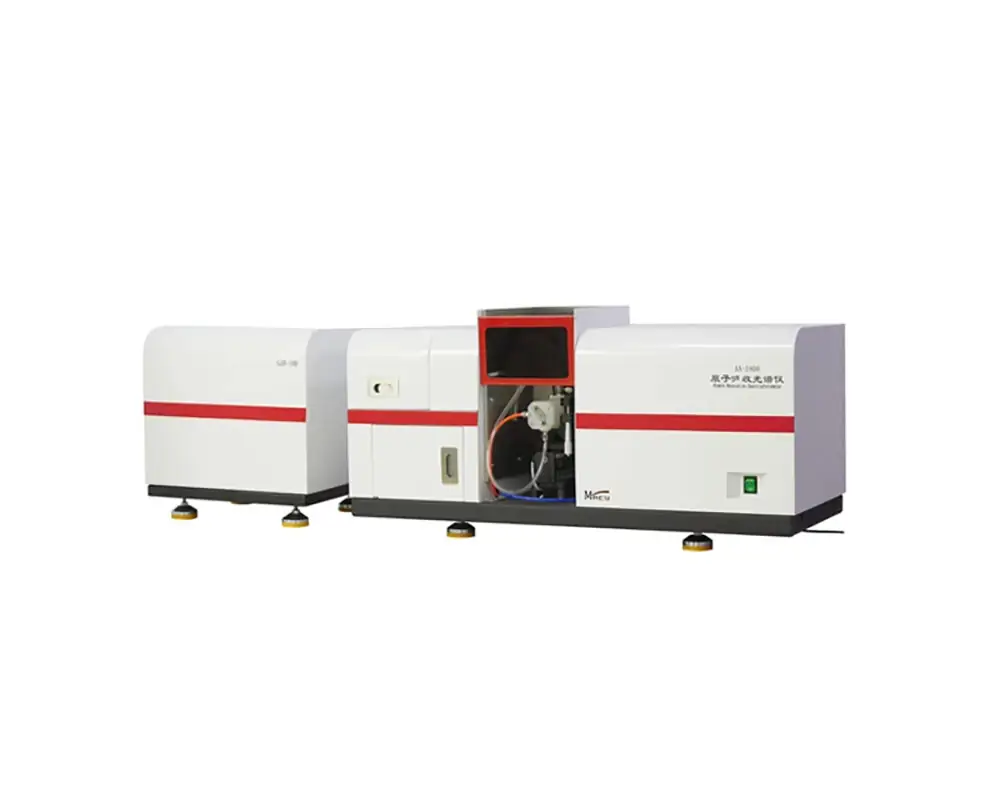
The MacyLab AA-1800E Atomic Absorption Spectrophotometer is designed to address this requirement by integrating Flame and Graphite Furnace functions into one analytical platform. This configuration allows laboratories to select the appropriate atomization mode based on sample concentration, matrix characteristics, and testing objectives.
From Routine Testing to Trace Element Measurement: One Platform for Different Analytical Needs
One of the key considerations when evaluating a graphite furnace atomic absorption spectrophotometer is whether the system can support different analytical scenarios without requiring separate instruments.
For routine elemental analysis, flame atomization provides an efficient approach for samples with relatively higher concentrations. When laboratories need to analyze trace elements at lower concentration levels, the graphite furnace mode provides a more sensitive measurement approach by introducing a small sample volume into a heated graphite tube.
The AA-1800E combines these two analysis modes within one system, allowing laboratories to move between routine and trace analysis according to actual testing requirements. This flexibility is particularly valuable for laboratories that analyze diverse sample types and do not want to maintain multiple atomic absorption systems.
Improving Analytical Confidence Through Flexible Sample Handling
Earlier sections discussed that sensitivity alone is not the only factor affecting GFAAS performance. Sample matrix, background interference, and method selection also influence final analytical results.
The AA-1800E supports laboratories by providing different atomization options for different sample conditions. When analyzing samples requiring graphite furnace analysis, users can apply furnace-based methods for trace element determination, while flame mode can be selected for routine concentration measurement.
This flexible workflow helps laboratories optimize testing procedures based on actual sample characteristics rather than using a single analytical approach for all applications.
A Practical Solution for Environmental, Food, and Industrial Laboratories
The demand for elemental analysis continues to grow across environmental monitoring, food safety, agriculture, metallurgy, chemical testing, and research laboratories.
In these applications, laboratories often need to analyze different elements and concentration ranges during daily operations. A combined Flame and Graphite Furnace system can provide a more adaptable solution compared with a single-function instrument.
The AA-1800E is positioned as a practical Trace Element Analyzer solution for laboratories requiring both routine elemental analysis and graphite furnace-based elemental analysis. Its combined configuration helps laboratories balance analytical flexibility, workflow efficiency, and instrument utilization.
FAQ About Graphite Furnace Atomic Absorption Spectrometer
Q1: What is the main advantage of a graphite furnace atomic absorption spectrophotometer?
A: The main advantage is higher sensitivity for trace element analysis. Compared with flame atomization, graphite furnace technology uses a smaller sample volume and provides controlled electrothermal atomization, making it suitable for low-concentration elemental measurement.
Q2: Why is background correction important in graphite furnace analysis?
A: Background correction helps reduce interference caused by complex sample matrices. It improves measurement reliability when samples contain substances that may affect absorption signals.
Q3: What factors affect graphite tube lifetime?
A: Graphite tube lifetime can be influenced by temperature programs, sample composition, operating conditions, and maintenance practices. Proper method optimization and regular maintenance can help improve tube usage efficiency.
Q4:Why choose a flame and graphite furnace atomic absorption system?
A: A combined flame and graphite furnace system allows laboratories to select different analytical modes according to sample concentration and testing requirements. It provides flexibility for laboratories handling both routine elemental analysis and graphite furnace applications
Conclusion
Choosing an atomic absorption system requires laboratories to balance sensitivity, application requirements, workflow efficiency, and long-term usability. While graphite furnace technology provides advantages for trace element analysis, many laboratories also need the efficiency of flame analysis for routine testing.
A combined Flame and Graphite Furnace system offers a practical approach by allowing laboratories to select different analytical modes according to sample concentration and testing objectives.
The MacyLab AA-1800E Atomic Absorption Spectrophotometer provides this flexibility by combining Flame and Graphite Furnace functions in one platform. For laboratories requiring both routine elemental analysis and graphite furnace-based trace analysis, the system can support a wider range of analytical workflows across environmental monitoring, food safety, industrial quality control, and research applications.
Before selecting a Graphite Furnace Atomic Absorption Spectrometer, laboratories should evaluate how well the instrument configuration matches their actual testing needs, sample types, and future analytical requirements. Contact us to discuss a suitable atomic absorption solution for your laboratory.