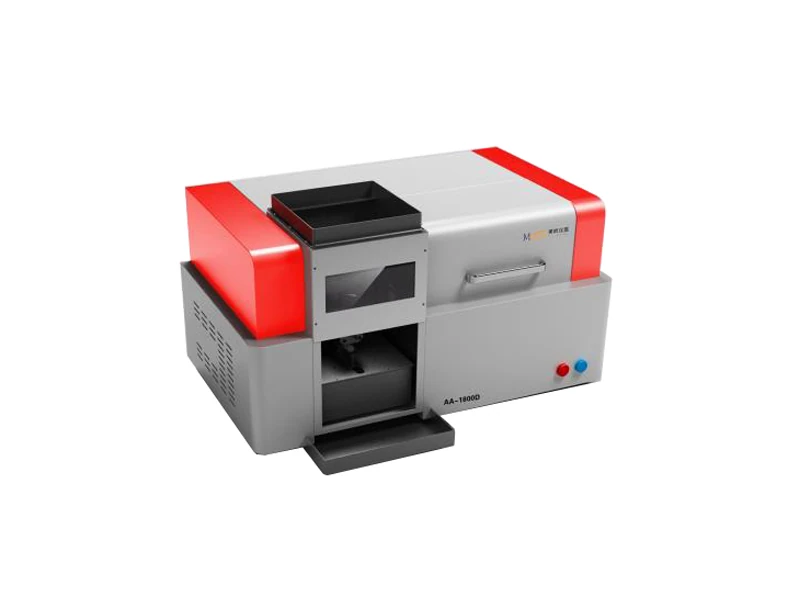
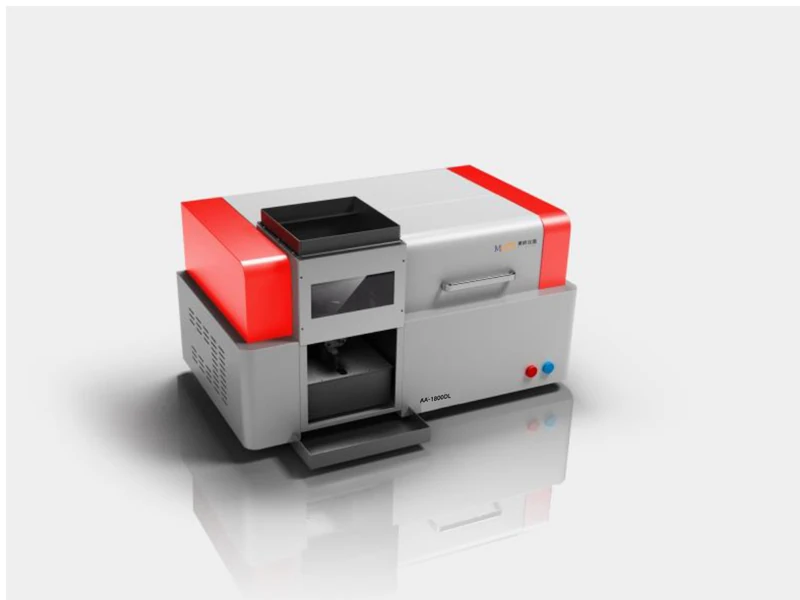
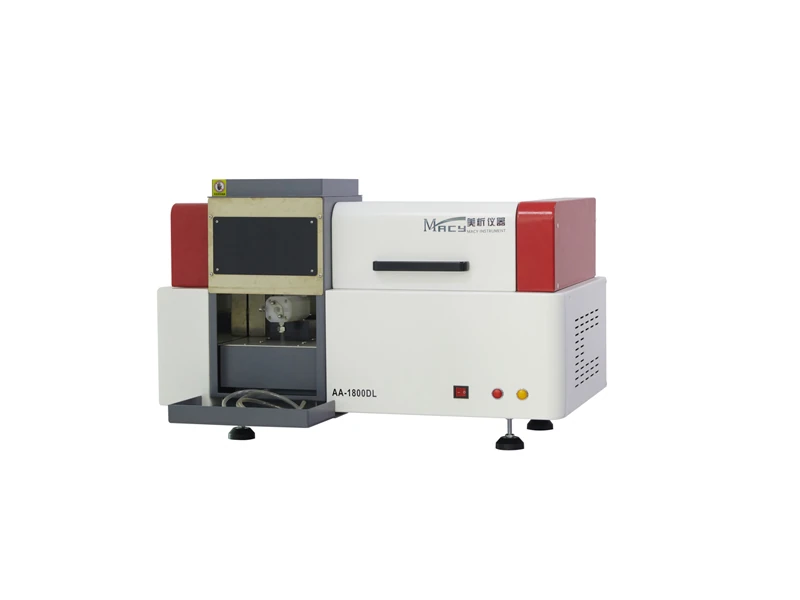
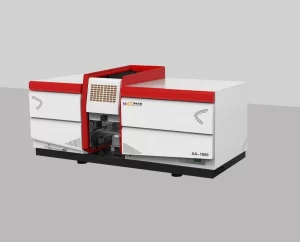
The Macylab AA-1800DL is an automatic Atomic Absorption Spectrophotometer designed for elemental analysis. Operating in the 185nm to 900nm wavelength range, it features a fully closed optical system built around a large 1800 lines/mm grating monochromator.
Equipped with a dedicated Flame Analytical System, the instrument utilizes intelligent control software to support automatic wavelength scanning, peak searching, and routine element detection. The software interface also supports automatic setup, optimization, and dilution procedures to streamline laboratory workflows.
Key Features
Corrosion-Resistant Flame System: Features a polymer explosion-proof spray chamber that provides resistance to acids and alkalis, including hydrofluoric acid. It is paired with an efficient glass atomizer and a full titanium combustion head.
Automatic Lamp Turret: Equipped with an automatic turret configuration that holds ≤8 lamps. The system supports direct use of high-performance hollow cathode lamps, automatic alignment, and automatic adjustment of power supply parameters.
Precision Optical System: Employs a large 1800 lines/mm grating monochromator and an imported photomultiplier tube (PMT) detector. It includes a specific 7-step automatic changeover spectral bandwidth (0.1 to 2.0 nm) and an automatic peak-finding function.
Automated Gas & Safety Control: The system integrates microcomputer-controlled automatic gas control. It automatically accomplishes safety ignition and extinction, helping to maintain a low fault rate and ensure the reproducibility of the flame method.
Intelligent Software: Features a user-friendly English operation interface. The software includes powerful functions for automatic setup menus, data correction, and automatic optimization. It is also programmed to support automatic switching between flame and graphite furnace operating modes.
Specifications
Parameter
Specification
Model
AA-1800DL
Light Source
≤8 lamps automatic turret, automatic alignment
Lamp Current
Pulsed power supply
Optical System
Large 1800 lines/mm grating ruling, full closed optical system
≤±0.002A/30 min (Static) | ≤±0.004A/30min (Dynamic)
Absorbance Range
0 – 4A
Detector
Imported photomultiplier tube
Burner Head (Flame)
Full titanium combustion head, 50mm or 100mm
Atomization Chamber
Polymer explosion-proof spray chamber
Nebulizer
Efficient glass atomizer
Ignition Type
Microcomputer control, automatic ignition
Gas Control
Automatic gas control system
Detection Limit (Cu)
0.002μg/mL
Precision
RSD ≤ 0.5%
Power Supply
110/220V (+5% ~ -10%), 60/50Hz; 5000VA
Applications
The AA-1800DL is utilized in scientific research, quality control, and industrial sectors for high-sensitivity trace elemental analysis:
Environmental Protection: Testing trace elements and heavy metals in environmental samples and water quality monitoring.
Agriculture and Food Testing: Analyzing nutritional elements and metallic contamination in agricultural products and fertilizers.
Metallurgy and Mining: Analyzing elemental compositions in ores, metallurgical materials, and industrial processes.
Chemical Industry: Routine quality control and element detection of chemical raw materials and manufacturing solutions.
Who is it for?
Quality Control Departments: QC labs in the chemical, agricultural, and metallurgical industries that require reliable and automated operation for routine flame-based element detection.
Environmental Testing Agencies: Water treatment facilities and environmental monitoring stations that demand a corrosion-resistant flame AAS for standard compliance testing.
Research Institutions: Organizations requiring a stable optical system with an extended 7-step spectral bandwidth for varying analytical requirements.
Why choose it?
Material Durability: The combination of a polymer spray chamber and a titanium burner ensures the instrument is highly resistant to corrosion and high-salt samples, protecting the core components during the analysis of harsh inorganic or organic solutions.
Optimized Optical Adjustments: Features a 7-step automatic changeover spectral bandwidth (ranging from 0.1 to 2.0nm) and a one-key optical optimization function for automatically finding peaks, reducing manual configuration errors.
Certified Qualifications: The instrument complies with major international product qualifications and safety standards, holding certifications including the European CE mark, North American ETL, FCC, RoHS, China CQC, and 3C.
Packaging, Installation & Operation
Packaging & Shipping
After unpacking the instrument, compare the contents with the packing list and check that all items are present and undamaged.
Installation & Setup
Place the spectrophotometer in a suitable location away from direct sunlight, dust, corrosive gases, and strong vibrations. For stable operation, keep it away from strong magnetic or electrical fields and electrical devices that may generate high-frequency fields.
Keep the area around and underneath the instrument clear to allow adequate airflow.
Use the appropriate power cord and connect the instrument to a grounded outlet.
Initial Operation
Turn on the spectrophotometer and allow it to warm up for the recommended time before taking measurements. Follow the instrument’s operating instructions to complete any required system initialization, calibration, or wavelength verification before measurement.
Exhibition
FAQ (Frequently Asked Questions)
The hardware specifications for the AA-1800DL standard configuration feature a dedicated Flame Analytical System. While the software is capable of controlling a graphite furnace and switching modes, a graphite furnace hardware module is not listed in the base technical parameters.
The instrument operates in the 185nm to 900nm wavelength range and features a 7-step automatic changeover spectral bandwidth (0.1, 0.2, 0.4, 0.7, 1.0, 1.4, 2.0 nm).
The flame system utilizes a full titanium combustion head, which is available in 50mm or 100mm specifications depending on the testing requirements.
The flame system features a microcomputer-controlled automatic gas control system that manages automatic safety ignition and extinction to maintain reliable operation.
The instrument requires a 110/220V (+5% ~ -10%), 60/50Hz power supply with a capacity of 5000VA.