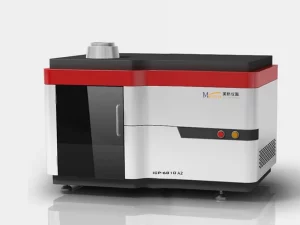
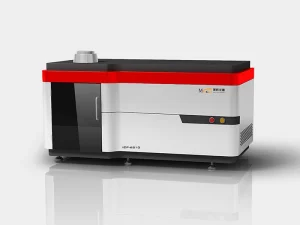
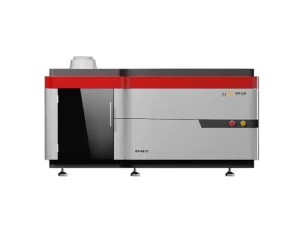
The Macylab ICP-6800 is a direct-reading Inductively Coupled Plasma Optical Emission Spectrometer (ICP-OES) designed for the quantitative determination of trace elements in various matrices. Operating with a 1000mm focal length Czerny-Turner optical system, the instrument analyzes liquid samples dissolved in common acids, including nitric acid, hydrochloric acid, and hydrofluoric acid.
Equipped with an imported Photomultiplier Tube (PMT) detector and a solid-state RF power supply featuring an automatic matching function, the ICP-6800 offers laboratories a highly configurable platform. By selecting the appropriate holographic grating, users can tailor the instrument for either high-resolution spectral separation or an extended measurement wavelength range.
Key Features
Solid-State RF Power Supply: Features an automatic load matching function operating at 27.12MHz. The output power is adjustable from 500W to 1600W, delivering a power output stability of < 0.3% to maintain a stable plasma discharge.
Configurable Czerny-Turner Optics: Employs a 1000mm focal length optical bench equipped with an ion beam etching holographic grating. Users can configure the system with a 3600 lines/mm grating or a 2400 lines/mm grating to match their specific analytical requirements.
Photomultiplier Tube (PMT) Detector: Integrates high-performance R293 or R928 PMT detectors powered by a stable negative high voltage supply (0-1000V, stability <0.05%), ensuring reliable photoelectric conversion of emission signals.
Robust Sample Introduction: The system includes a three-concentric torque tube (20mm external diameter), a 6mm coaxial nebulizer, and a 34mm double barrel atomizing chamber to support effective aerosol generation and sample delivery.
Precise Gas Regulation: Carrier, plasma, and auxiliary Argon gas flows are controlled through dedicated flowmeters, alongside a 0-0.4MPa pressure maintaining valve to ensure safe and stable plasma operation.
Specifications
Parameter
Specification
Model
ICP-6800
Circuit Type (RF)
Solid-state RF power supply, auto-match function
RF Frequency
27.12MHz ±0.05%
Power Output
500 — 1600W
Power Output Stability
< 0.3%
Escaped RF Radiation
E < 2V/m (at 30cm from the instrument)
Optics
Czerny-Turner type
Focal Length
1000 mm
Grating Options
Ion Beam Etching Holographic, 3600 L/mm or 2400 L/mm
The ICP-6800 is utilized for trace elemental analysis in standard industrial and analytical fields:
Metallurgy and Minerals: Determining trace elements and elemental compositions in ores, metals, and alloy materials.
Environmental Testing: Analyzing heavy metal contamination in water quality testing and soil extracts.
Chemical Industry: Routine quality control testing of chemical raw materials and industrial manufacturing solutions.
Agricultural Research: Testing trace elements and nutrients in soils, plant extracts, and fertilizers.
Who is it for?
Quality Control Laboratories: QC departments in chemical and metallurgical plants that require an established PMT-based ICP-OES for standard compliance testing.
Environmental Testing Agencies: Facilities focused on water and soil analysis that need to monitor trace elements reliably over time.
Research Institutions: Organizations that prefer the configurable resolution of a Czerny-Turner optical system combined with stable PMT detection for specific analytical tasks.
Why choose it?
Adaptable Optical Performance: By offering two grating options, the instrument can be tailored to the laboratory’s analytical focus. The 3600 lines/mm grating provides an exceptional resolution of ≤0.007nm for complex emission spectra, while the 2400 lines/mm grating extends the wavelength range up to 800nm to cover elements emitting in the visible spectrum.
RF Power Stability: The solid-state RF power supply with its automatic matching function ensures consistent plasma ignition and continuous operation, preventing power fluctuations from affecting analytical readings.
Certified Qualifications: The instrument complies with major international product qualifications and safety standards, holding certifications including the European CE mark, North American ETL, FCC, RoHS, China CQC, and 3C.
Packaging, Installation & Operation
Packaging & Shipping
After unpacking the instrument, compare the contents with the packing list and check that all items are present and undamaged.
Installation & Setup
Place the spectrophotometer in a suitable location away from direct sunlight, dust, corrosive gases, and strong vibrations. For stable operation, keep it away from strong magnetic or electrical fields and electrical devices that may generate high-frequency fields.
Keep the area around and underneath the instrument clear to allow adequate airflow.
Use the appropriate power cord and connect the instrument to a grounded outlet.
Initial Operation
Turn on the spectrophotometer and allow it to warm up for the recommended time before taking measurements. Follow the instrument’s operating instructions to complete any required system initialization, calibration, or wavelength verification before measurement.
Exhibition
FAQ (Frequently Asked Questions)
The wavelength range depends on the selected grating configuration. With the 3600 lines/mm grating, the range is 190nm to 500nm. With the 2400 lines/mm grating, the range extends from 190nm to 800nm.
The ICP-6800 utilizes an imported Photomultiplier Tube (PMT) detector (specifications R293 or R928) to measure emission signals.
Yes, the RF generator and working coil require a cooling water supply. The specifications require a water temperature of 20-25℃, a flow rate of >5L/min, and a hydraulic pressure of >0.1MPa.
Yes. The instrument is designed to analyze substances dissolved in various matrices, including nitric acid, hydrochloric acid, and hydrofluoric acid.
The instrument relies on dedicated flowmeters to regulate the gas supply. The plasma argon flow is adjustable from 100-1000 L/h, while both the auxiliary and carrier argon flows are adjustable from 10-100 L/h.