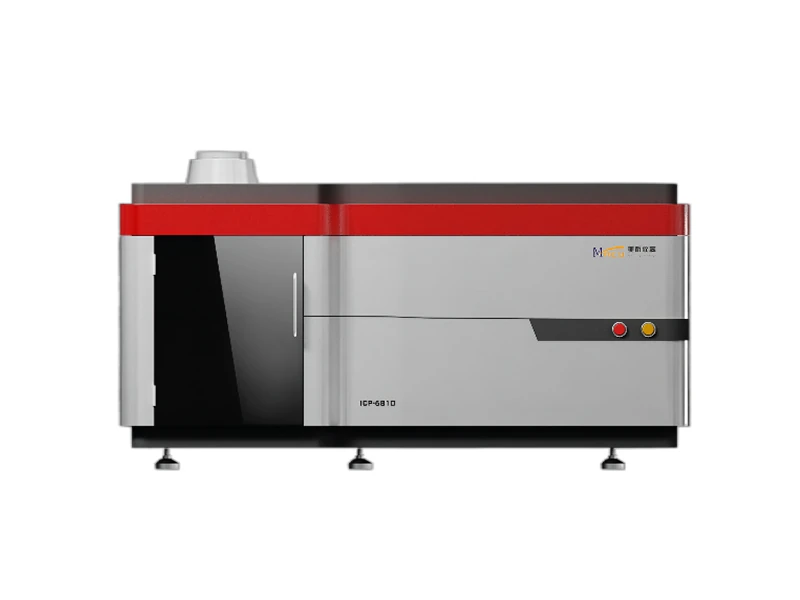
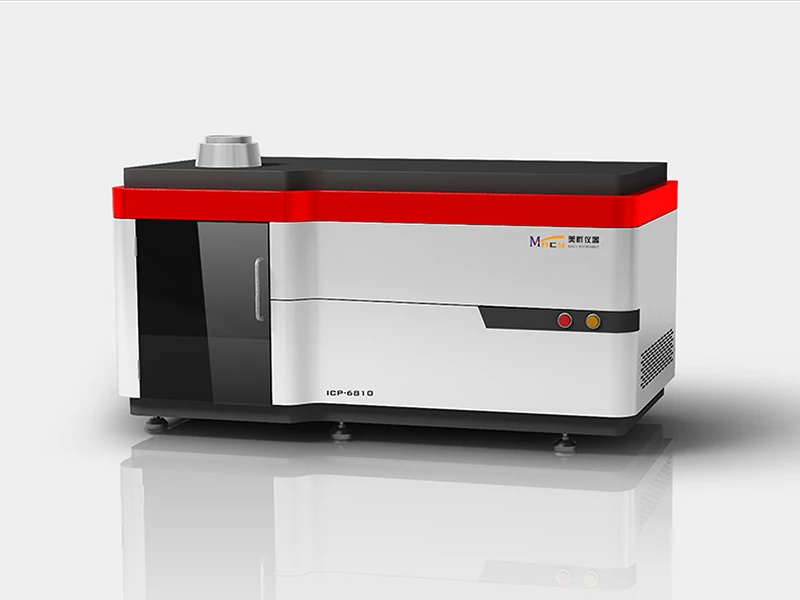
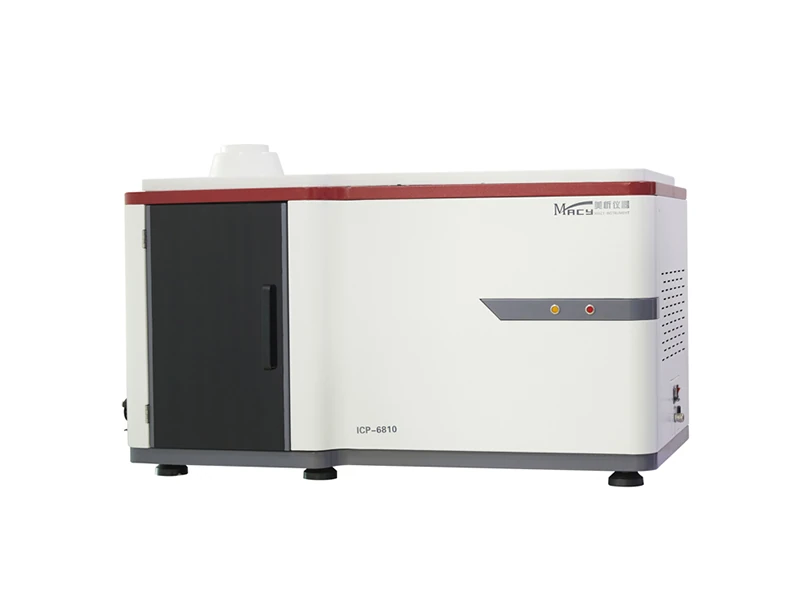
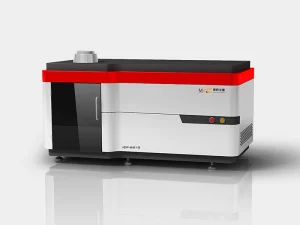
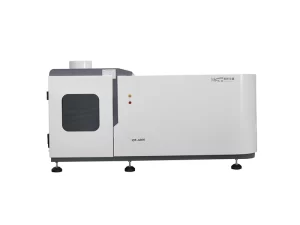
The Macylab ICP-6810 is a full-spectrum, direct-reading Inductively Coupled Plasma Optical Emission Spectrometer (ICP-OES) engineered for the quantitative determination of trace and major elements. Operating across a wavelength range of 165nm to 950nm, the instrument is designed to analyze samples digested in various acids, including nitric acid, hydrochloric acid, and hydrofluoric acid.
The system utilizes an echelle grating and prism cross-dispersion optical design with no moving optical parts. Integrated with a large-area Charge-Coupled Device (CCD) detector, the ICP-6810 captures the intensity integral values of all analyzed spectral lines in a single exposure, allowing the target elements in a sample to be measured within one minute.
Key Features
Solid-State RF Power Supply: Equipped with an automatic load matching technology that provides a 500–1600W output power. The RF generator operates with an output power stability of <0.1%, supporting stable plasma generation and continuous sample excitation.
Automated Sample Introduction: Features a 12-rotor, 4-channel peristaltic pump with adjustable speed control. Carrier gas, plasma gas, and auxiliary gas flows are accurately regulated by integrated mass flow controllers to ensure stable gas delivery.
High-Resolution Optical System: Employs a medium step grating (52.67 lp/mm) and a Corning ultraviolet fused silica prism. This fixed optical design provides a high resolution of <0.0068nm at 200nm.
Large-Area CCD Detector: Incorporates a 27.6mm × 27.6mm CCD detector containing 1024 × 1024 addressing detection units. The detector is maintained at -45℃ using a three-stage semiconductor cooling system to reduce dark current and improve signal detection.
Matrix Adaptability: The sample introduction module can be equipped with optional components, including imported high-salt atomizers or hydrofluoric acid (HF) resistant atomizers, to accommodate challenging sample matrices.
Constant Temperature Light Chamber: The precision optical chamber is maintained at a constant 35 ± 0.1℃ and utilizes a distributed nitrogen purging system (normal 2L/min, rapid 4L/min) to support measurement stability in the ultraviolet region.
Specifications
Parameter
Specification
Model
ICP-6810
Wavelength Range
165nm – 950nm
Optical System
Echelle grating (52.67 lp/mm) and prism cross-dispersion
Optical Resolution
< 0.0068 nm @ 200nm
Detector
CCD detector (1024 × 1024 pixels)
Detector Cooling
Three-stage semiconductor cooling to -45℃
RF Generator Power
500W – 1600W (Output stability <0.1%)
Sample Injection
12-rotor, 4-channel peristaltic pump
Gas Flow Control
Mass flow controllers (Carrier, Plasma, Auxiliary)
Light Chamber Temp
Constant 35 ± 0.1 ℃
Purge Gas
Nitrogen (Distributed purging)
Liquid Content Range
0.01ppm ~ several thousand ppm
Solid Content Range
0.001% ~ 70%
Short-term Stability
RSD < 1%
Long-term Stability
RSD < 1.5% @ 2 hours
Power Requirements
220VAC, 20A
Applications
The ICP-6810 is utilized in industrial, environmental, and scientific fields for multi-element quantitative testing:
Geological and Ore Analysis: Determination of elements such as Ca, Mg, Na, Fe, Cu, Mn, Zn, Co, Ni, Au, and Ag in rock and soil extracts.
Petrochemical Industry: Testing more than 30 elements in crude oil and petroleum products, primarily evaluating Fe, Na, Mg, Ni, V, Ca, Pb, and Mo.
Metallurgy and Silicon Processing: Analyzing trace impurity elements (e.g., As, Bi, Pb, Sb, Sn) that impact the quality of metal and magnetic materials.
Environmental and Water Quality: Detecting heavy metals and elemental pollutants in wastewater, drinking water, and environmental compliance testing.
Who is it for?
Commercial Testing Laboratories: Facilities processing large volumes of liquid samples daily that require an instrument capable of rapid simultaneous readout of all elements.
Industrial Quality Control Departments: QC labs in the petrochemical, metallurgical, and semiconductor sectors that require stable testing across a broad dynamic range.
Scientific Research Institutions: Organizations requiring reliable quantitative analysis for applications in agricultural research, environmental science, and clinical testing.
Why choose it?
High Analytical Throughput: By utilizing a large-area CCD detector without moving optical components, the instrument performs simultaneous exposure and readout. The readout time of a single spectral line is less than 2ms, significantly accelerating the analysis process.
Configurable for Complex Matrices: The ability to configure the system with high-salt or HF-resistant atomizers ensures that samples digested in hydrofluoric acid or featuring high dissolved solids can be processed effectively without damaging the introduction hardware.
Instrument Stability: The integration of a solid-state RF power supply, mass flow controllers for precise gas management, and a thermally stabilized optical chamber helps maintain a short-term stability RSD of <1% and a long-term stability of <1.5% over two hours.
Certified Qualifications: The instrument complies with major international product qualifications and safety standards, holding certifications including the European CE mark, North American ETL, FCC, RoHS, China CQC, and 3C.
Packaging, Installation & Operation
Packaging & Shipping
After unpacking the instrument, compare the contents with the packing list and check that all items are present and undamaged.
Installation & Setup
Place the spectrophotometer in a suitable location away from direct sunlight, dust, corrosive gases, and strong vibrations. For stable operation, keep it away from strong magnetic or electrical fields and electrical devices that may generate high-frequency fields.
Keep the area around and underneath the instrument clear to allow adequate airflow.
Use the appropriate power cord and connect the instrument to a grounded outlet.
Initial Operation
Turn on the spectrophotometer and allow it to warm up for the recommended time before taking measurements. Follow the instrument’s operating instructions to complete any required system initialization, calibration, or wavelength verification before measurement.
Exhibition
FAQ (Frequently Asked Questions)
The instrument covers a full-spectrum wavelength range from 165nm to 950nm, supporting the analysis of elements that emit in both the deep ultraviolet and visible-near-infrared regions.
Yes. The sample introduction system can be configured with an optional HF-resistant atomizer, making it suitable for analyzing geological or semiconductor samples digested in hydrofluoric acid.
No. The ICP-6810 utilizes an echelle grating and prism cross-dispersion method with no moving optical components. Wavelength calibration and spectral line identification are handled automatically by the instrument’s software algorithms.
The carrier gas, plasma gas, and auxiliary gas are controlled by integrated mass flow controllers. This ensures precise flow rates to maintain plasma stability during testing.
The CCD detector is cooled using a three-stage semiconductor cooling module, which lowers the operating temperature to -45℃ to reduce dark current and improve signal detection.