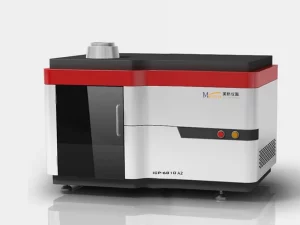
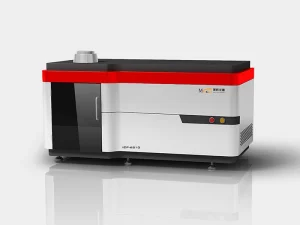
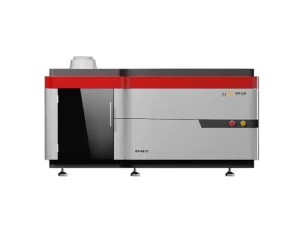
The Macylab ICP-6800D is a Dual-System Inductively Coupled Plasma Optical Emission Spectrometer (ICP-OES) engineered for comprehensive elemental analysis. It combines the capabilities of a standard aqueous analysis system and a dedicated petrochemical system into a single analytical platform.
Operating on a solid-state RF power supply and a scanning Czerny-Turner optical system equipped with a Photomultiplier Tube (PMT) detector, the instrument allows laboratories to test both inorganic solutions (dissolved in acids like hydrochloric, nitric, and hydrofluoric acid) and organic petroleum samples. By switching the sample introduction system, operators can analyze standard samples or oil samples without requiring two separate ICP-OES machines.
Key Features
Dual-System Adaptability: Integrates both standard and petrochemical sample injection systems. Operators can switch between the aqueous configuration for standard inorganic samples and the specialized petrochemical configuration for oil and organic solvent samples.
Solid-State RF Power Supply: Features an automatic load matching technology operating at a frequency of 27.12MHz. It provides an adjustable output power between 800W and 1200W with an output stability of < 0.3%, ensuring stable plasma generation even under heavy organic loads.
Automated Injection & Gas Control: Utilizes a four-channel automated peristaltic pump where the rotational speed can be adjusted according to test demands. The carrier gas, plasma gas, and auxiliary gas are precisely regulated by advanced mass flow controllers.
Specialized Nebulizer Compatibility: The sample introduction module can be equipped with imported high-salt nebulizers and hydrofluoric acid (HF) resistant nebulizers to handle various complex and challenging matrices.
Czerny-Turner Optical System: Employs a 1000mm focal length optical bench. Depending on the configured holographic grating (3600 lines/mm or 2400 lines/mm), the instrument provides specific optical resolutions to suit different analytical requirements.
Specifications
Parameter
Specification
Model
ICP-6800D
System Configuration
Dual System (Standard Aqueous + Petrochemical)
Circuit Type (RF)
Solid-state RF power supply, auto-match function
RF Frequency
27.12MHz ±0.05%
RF Frequency Stability
< 0.1%
Output Power
800W – 1200W (adjustable)
Power Output Stability
< 0.3%
Optics
Czerny-Turner type
Focal Length
1000 mm
Grating Options
Ion Beam Etching Holographic, 3600 L/mm or 2400 L/mm
Mass flow controllers (Carrier, Plasma, Auxiliary)
Instrument Stability
RSD < 1.5%
Dimensions / Weight
125 × 69.3 × 64.5 cm | 205 kg
Applications
The ICP-6800D is utilized for trace elemental analysis across diverse industrial and analytical fields:
Petrochemical Industry: Determining trace elements and metals in crude oil, organic solvents, lubricating oils, and refined petroleum products using the dedicated petrochemical system.
Materials & Chemical Engineering: Routine quality control testing for chemical raw materials, alloys, and industrial manufacturing solutions.
Geological & Environmental Testing: Analyzing heavy metals and trace elements in rock, soil extracts, and water samples dissolved in strong acids (including hydrofluoric acid).
General Laboratory Testing: Capable of multi-element determination in standard inorganic matrices using the standard aqueous injection system.
Who is it for?
Comprehensive Testing Laboratories: Facilities that process a mixed volume of environmental/aqueous samples and petrochemical/organic samples, requiring a single instrument capable of effectively covering both matrices.
Industrial Quality Control Departments: QC labs in chemical and petrochemical manufacturing plants that need to switch between raw material purity testing (aqueous) and final product analysis (organic).
Research Institutions: Organizations that benefit from the flexibility of a dual-system ICP-OES to support varied scientific research applications.
Why choose it?
Consolidated Equipment Profile: By incorporating a dual-system setup, the ICP-6800D allows laboratories to process both standard and petrochemical samples on one platform, which conserves laboratory bench space and optimizes equipment procurement budgets.
Stable Plasma for Organics: The combination of a robust RF power supply and mass flow gas control helps maintain plasma stability when introducing organic solvents, which can typically cause plasma fluctuations or extinction in standard aqueous-only instruments.
Configurable Optical Resolution: The instrument allows laboratories to choose the grating specification (2400 or 3600 lines/mm) to match their specific required analytical resolution and wavelength range.
Packaging, Installation & Operation
Packaging & Shipping
After unpacking the instrument, compare the contents with the packing list and check that all items are present and undamaged.
Installation & Setup
Place the spectrophotometer in a suitable location away from direct sunlight, dust, corrosive gases, and strong vibrations. For stable operation, keep it away from strong magnetic or electrical fields and electrical devices that may generate high-frequency fields.
Keep the area around and underneath the instrument clear to allow adequate airflow.
Use the appropriate power cord and connect the instrument to a grounded outlet.
Initial Operation
Turn on the spectrophotometer and allow it to warm up for the recommended time before taking measurements. Follow the instrument’s operating instructions to complete any required system initialization, calibration, or wavelength verification before measurement.
Exhibition
FAQ (Frequently Asked Questions)
The standard ICP-6800 is configured primarily for standard aqueous samples. The ICP-6800D is a dual-system model that includes both standard and petrochemical injection systems. This allows the instrument to test standard inorganic solutions as well as organic petroleum samples by changing the introduction module.
The solid-state RF power supply provides an adjustable output power of 800W to 1200W, operating at a frequency of 27.12MHz with an automatic matching function.
Yes. The sample introduction system can be configured with a hydrofluoric acid-resistant nebulizer to safely process samples digested in HF.
The instrument utilizes an imported Photomultiplier Tube (PMT) detector to measure the intensity of the elemental emission spectral lines.
The carrier gas, plasma gas, and auxiliary gas are all controlled automatically by advanced mass flow controllers to ensure precise and repeatable gas flow rates during analysis.