What Is a UV-Vis Spectrophotometer? Working Principle, Applications, and Buying Guide
What Is a UV-Vis Spectrophotometer?
Researchers and lab staff in academia, pharmaceutical quality control, environmental detection, and material research often use a UV-Vis Spectrophotometer. This common lab tool measures how much light samples absorb in the UV and visible light ranges. Operators use the test results to identify unknown substances and measure the concentration of liquid, solid, and gas samples (Chemistry LibreTexts, 2023).
Most professional labs adopt a double-beam spectrophotometer for daily and high-precision tests. It splits light into two separate optical paths, with one beam passing through the test sample and the other through a blank reference solution simultaneously. This design offsets errors from unstable light sources, temperature changes and external interference. It delivers more stable and accurate data for long-term and batch sample testing.
As a reliable UV-Vis spectrophotometer manufacturer, Macy Lab Instruments develops user-friendly and high-precision spectrophotometers for global labs. This practical guide explains the working principles, mainstream applications, and key purchasing factors,which can help labs select suitable and cost-effective testing equipment.
How Does a UV-Vis Spectrophotometer Work?
The Principle of UV-Visible Absorption Measurement
All UV-Vis testing follows the Beer-Lambert Law. This rule serves as the core basis for all absorbance testing (NIST Chemistry WebBook, 2025). The rule is simple and easy to understand. A sample with a higher concentration absorbs more light. Each chemical substance absorbs light differently at different wavelengths. This feature helps lab workers identify unknown substances and calculate accurate sample concentrations.
All UV-Vis spectrophotometers follow the same simple testing steps. The instrument turns on internal lamps first. These lamps produce stable and visible light. The internal monochromator filters the mixed light. It turns wide-spectrum light into a single, accurate wavelength. The targeted light passes through a blank solution and the prepared sample in turn. The detector records how much light passes through the samples. The instrument’s internal processing system reads these optical signals. It turns the signals into intuitive absorbance data and full spectral graphs for lab staff to view and analyze.
Main Components of a UV-Vis Spectrophotometer
A qualified UV-Vis Spectrophotometer relies on six key hardware parts to deliver accurate and stable test results. Dual professional lamps support full UV and visible light testing for most lab tasks.A high-precision holographic grating helps the machine to lock target wavelengths precisely and to reduce spectral errors. The dual optical path is the core advantage of a double-beam spectrophotometer, and it can achieve real-time reference calibration during tests. The flexible sample chamber fits different cuvette sizes to meet various sample testing needs. A high-sensitivity silicon photodiode detector picks up weak optical signals and effectively avoids noise interference. The built-in microcomputer system processes all test data and shows clear results on the LCD screen for easy viewing.
What Are the Applications of UV-Vis Spectrophotometers?
Biological and Life Science Research
Modern life science labs rely on qualified equipment from a professional UV-Vis spectrophotometer manufacturer for daily molecular testing. Researchers commonly use this instrument to test DNA and protein samples. It uses fixed wavelengths of 260nm, 280nm, and 320nm. It can accurately check sample concentration and biological purity. The device also tracks real-time enzyme reactions. It monitors microbial growth to support cell culture and microbiology tests.
This instrument also serves agricultural and plant science research. Lab workers test plant leaf pigments such as chlorophyll and carotenoids. The changes in these pigment contents can show plant growth conditions. Workers can also test antioxidant enzyme activity. These data help users judge plant nutrient deficiency and disease resistance against external pathogens.
Chemical and Pharmaceutical Analysis
Pharmaceutical manufacturing and quality control labs use UV-Vis spectrophotometers for mandatory routine inspections. Technicians test raw material purity, active pharmaceutical ingredient (API) content, and trace impurity levels to comply with global industry standards. Users can build precise standard curves with up to 10 calibration samples and multiple fitting modes available to match complex quantitative testing requirements for different chemical compounds.
In general chemistry research, full-spectrum wavelength scanning helps identify unknown organic substances by matching unique absorption peaks. It also delivers accurate quantitative data for dissolved metal ions in inorganic solution testing, supporting both academic experiments and industrial component analysis.
Environmental Monitoring and Material Testing
Environmental monitoring teams often use UV-Vis spectrophotometers to check water quality. This instrument can effectively find heavy metal residues, nitrites and organic pollutants in various water bodies. It covers drinking water, surface water and factory wastewater. The test data provides valid support for environmental inspection and compliance work.
Material science fields also benefit from this tool. It tests light transmittance of plastic films and glass materials, measures color difference of surface coatings and textiles, and evaluates material aging performance via UV spectral scanning. Its broad wavelength range covers both ultraviolet aging detection and visible light color analysis scenarios.
Key Factors to Consider When Buying a UV-Vis Spectrophotometer
Wavelength Range and Measurement Accuracy
For universal laboratory use, prioritize devices with a complete 190–1100nm wavelength range. Narrow-band devices can only support partial testing and cannot meet diverse organic and inorganic analysis needs. Always verify two core accuracy indicators before purchasing: wavelength accuracy of ±0.5nm and stray light value ≤0.04%τ. These parameters guarantee stable and credible detection results, especially for low-concentration trace sample testing.
Photometric Performance and Stability
Long-duration kinetic and dynamic reaction experiments demand excellent instrument stability. High-quality spectrophotometers achieve 0.001A/h stability at 500nm, meaning baseline drift remains negligible during hours of continuous testing. A double-beam spectrophotometer outperforms single-beam alternatives significantly in this aspect. Its dual-path design automatically compensates for light source decay and ambient environmental changes, eliminating repeated blank calibration and baseline errors.
Software Functions and Data Processing Capability
Practical lab spectrophotometers require comprehensive built-in software functions instead of basic single-test modes. Essential features include full-band wavelength scanning, real-time kinetic testing, multi-wavelength synchronous detection, and standard quantitative analysis. Premium models can achieve automatic data storage, power-off parameter retention, professional report printing, and PC terminal connection. These functions avoid repetitive calibration work and greatly improve laboratory testing efficiency.
Sample Compatibility and Testing Requirements
Laboratories can choose spectrophotometers with adaptable sample chambers that support cuvettes ranging from 5mm to 100mm. This design adapts to tiny biological samples like nucleic acid solutions and concentrated industrial samples. Labs can use different cuvettes for targeted tests. Quartz cuvettes adapt to ultraviolet detection, and glass cuvettes work for conventional visible light testing. This basic configuration meets most daily laboratory analysis needs.
UV-1500 UV-Vis Spectrophotometer: A Reliable Solution for Laboratory Analysis
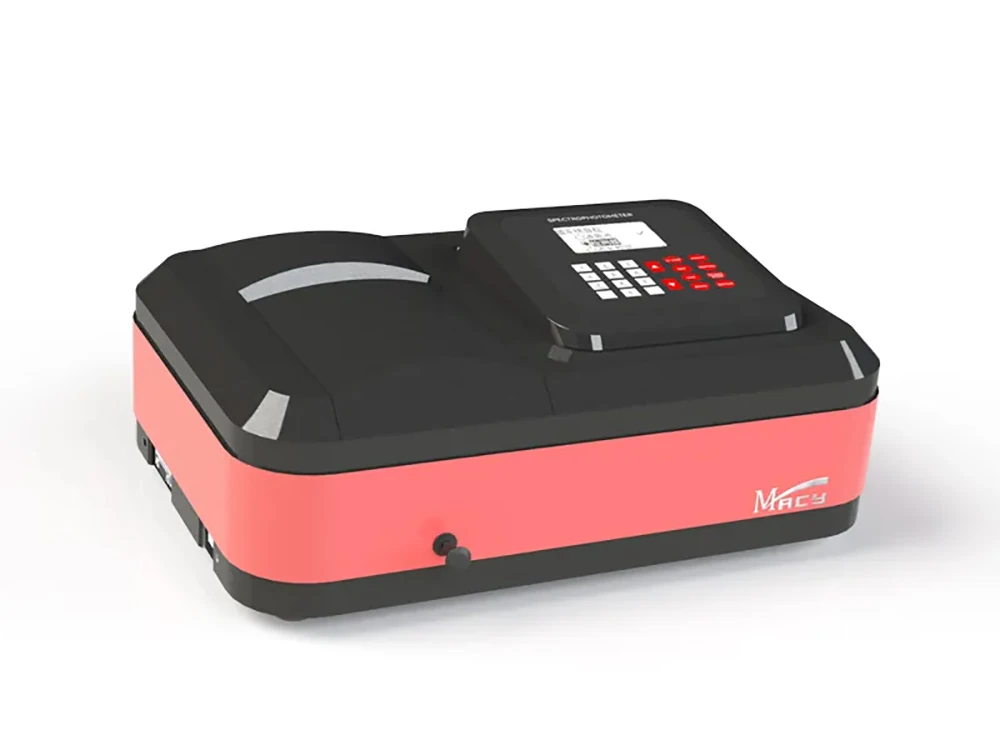
The UV-1500 is a high-cost-performance, fully automatic UV-Vis Spectrophotometer built for multi-industry laboratory analysis.
| Specification Item | UV-1500 Parameter |
| Wavelength Range | 190~1100nm |
| Band Width | 2nm |
| Wavelength Accuracy | ±0.5nm |
| Stray Light | ≤0.04% τ |
| Stability | 0.001A/h@500nm |
| Weight | 11Kg |
Wide Wavelength Range from 190nm to 1100nm
The UV-1500 UV-Vis Spectrophotometer covers the full spectrum of ultraviolet and visible light. It has no missing testing wavelength ranges. The device uses imported deuterium lamps and tungsten halogen lamps. These two light sources provide steady light for all testing wavelengths. Users can finish multiple testing tasks with just one machine. The tasks include organic substance identification, metal ion concentration testing, and full-spectrum material scanning. This design meets most daily lab testing scenarios.
Automatic Wavelength Adjustment and Multiple Measurement Modes
This practical double-beam spectrophotometer features automatic wavelength calibration and filter switching. Operators do not need to adjust the device manually during tests. This design effectively cuts down human errors that often occur with basic spectrophotometer models. The instrument provides four standard testing modes, including transmittance, absorbance, concentration and energy detection. These modes fully meet daily laboratory testing standards. The equipment supports real-time baseline correction. Lab staff can process batch samples continuously without repeated blank calibration. This core feature greatly boosts overall laboratory testing efficiency.
DNA, Protein, Kinetic, and Multi-Wavelength Analysis Functions
The product integrates all common advanced testing functions for modern labs. The built-in DNA and protein module can calculate sample concentration and purity ratios automatically. The kinetic testing module tracks continuous chemical reactions for up to 9 hours. Users can adjust sampling intervals to fit different enzyme experiments. The multi-wavelength testing function detects more than ten wavelength data points at the same time. It helps users screen mixed samples quickly. The quantitative module can save standard curve data permanently. It also supports one-click report generation and printing for convenient data sorting.
Application Case: UV-Vis Spectrophotometer in Plant Health and Disease Research
In plant pathology and agricultural research, the UV-1500 delivers reliable, all-round testing for common plant analysis needs. It accurately quantifies key leaf pigments like chlorophyll and carotenoids, whose concentration changes directly reflect leaf aging, nutrient deficiency, and pathogen infection severity. The device also tracks real-time absorbance shifts during enzymatic reactions to measure antioxidant enzyme activity, helping researchers evaluate plant stress and disease resistance. Additionally, it calculates microbial density in plant tissue extracts and culture solutions via fixed-wavelength absorbance testing, which can help to achieve routine microbial growth monitoring and pathogenic mechanism studies for plant health research.
Conclusion: Choosing the Right UV-Vis Spectrophotometer for Your Research Needs
When selecting a spectrophotometer, labs should prioritize matching device performance with actual testing demands . Basic teaching laboratories can adopt cost-effective single-beam devices for simple quantitative experiments. For pharmaceutical quality control, environmental monitoring, and high-precision life science research, a stable double-beam spectrophotometer is the most practical choice.
Labs can get stable product quality and comprehensive after-sales technical support by cooperating with a professional UV-Vis spectrophotometer manufacturer. The UV-1500 spectrophotometer features precise detection performance, complete functional modules and reasonable pricing. It can adapt to most scientific research and industrial laboratory testing work, and it works as a versatile daily analysis tool for various labs.
Frequently Asked Questions About UV-Vis Spectrophotometers
What Is a UV-Vis Spectrophotometer Used For?
A: A UV-Vis Spectrophotometer is one of the most common, easy-to-use analytical tools in any modern lab. Simply put, it measures how much light a sample absorbs to identify unknown substances or calculate exact sample concentrations. It serves common lab fields including life science, pharmaceutical testing, environmental analysis, material detection and agricultural research.
What Is the Difference Between UV and UV-Vis Spectrophotometers?
A: Single UV spectrophotometers only support 190–400nm ultraviolet band testing, with no visible light detection capability. UV-Vis spectrophotometers extend coverage to the 400–1100nm visible light range, supporting more testing items and adapting to broader laboratory application scenarios.
What Samples Can Be Tested Using a UV-Vis Spectrophotometer?
A: This device is suitable for transparent liquid solutions, thin transparent solid films, and diluted gas samples. Opaque solid samples need pre-treatment and extraction into transparent solutions before spectrophotometric testing.
How Do I Select the Right Spectrophotometer for My Laboratory?
A:Laboratories can follow simple rules to select a suitable spectrophotometer. Labs should pick devices with a full 190–1100nm wavelength range for routine tests. High-precision and batch testing scenarios suit a standard double-beam spectrophotometer. Users need to confirm device functions match daily experimental needs. Choosing a professional UV-Vis spectrophotometer manufacturer also guarantees reliable product quality and solid after-sales service.