What Makes a Double-Beam UV-Visible Spectrophotometer the Right Choice for Your Laboratory?
Introduction
In the world of analytical chemistry, precision is not negotiable. Whether you are measuring the concentration of an active pharmaceutical ingredient, detecting heavy metals in drinking water, or quantifying food additives, the instrument you choose directly impacts the reliability of your results. Among the various options available, the Double-beam UV-visible spectrophotometer has emerged as a preferred solution for laboratories that demand accuracy, stability, and efficiency. The global UV-Vis spectroscopy market is valued at approximately USD 1.3 billion in 2024 and is projected to reach around USD 1.7 billion by 2029, growing at a CAGR of about 4.9%. (Source: https://www.researchandmarkets.com/reports/5187575/ultraviolet-visible-spectroscopy-market-size) This article explores what this technology offers, how it works, its key specifications.
What is a Double-beam UV-visible spectrophotometer?
A Spectrophotometer is an analytical instrument that measures the amount of light absorbed or transmitted by a sample at specific wavelengths. The term UV-Vis spectrophotometer refers to instruments that operate in the ultraviolet (190–380 nm) and visible (380–1100 nm) regions of the electromagnetic spectrum.
A Double-beam UV-visible spectrophotometer differs from a single-beam system in a key way: it splits the light source into two paths. One passes through the sample, while the other goes through a reference, such as a blank solvent. Because both signals are measured at the same time, the system can continuously correct for fluctuations in light intensity and detector response.
In a single-beam design, the reference measurement must be taken separately, which introduces temporal errors. A double-beam design eliminates this problem, delivering superior baseline stability and repeatability.
Key Specifications of the Macylab UV-1800 Model
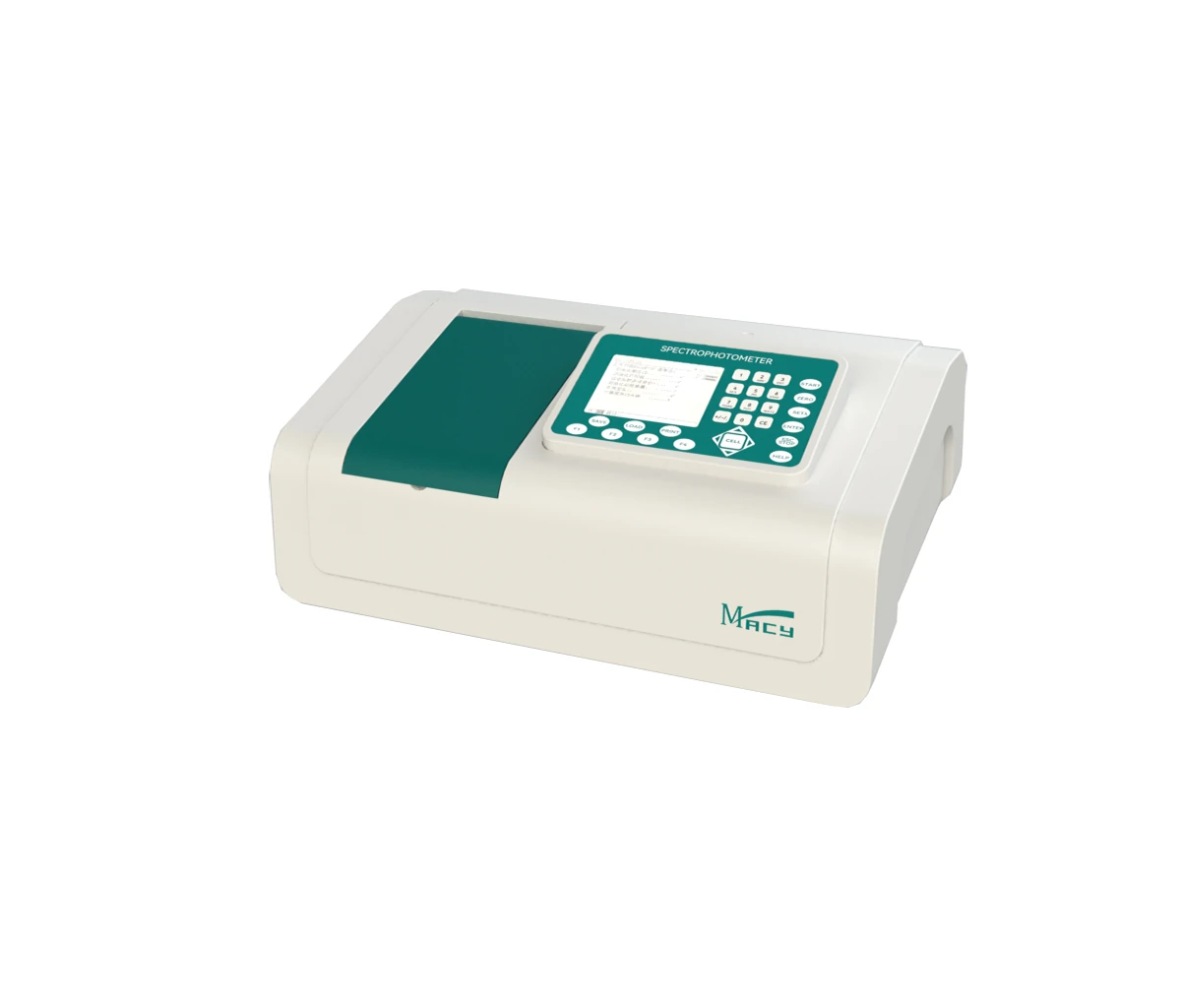
The UV-1800 is a Double-beam UV-visible spectrophotometer designed for routine and research applications. Its key specifications are listed below based on factory and third-party calibration data.
| Parameter | Specification |
| Optical structure | Double-beam |
| Wavelength range | 190 nm – 1100 nm |
| Spectral bandwidth | 2 nm (1 nm optional) |
| Wavelength accuracy | ±0.3 nm |
| Wavelength repeatability | ≤0.1 nm |
| Wavelength scanning speed | 13000 nm/min (movement); 4500 nm/min (max scan) |
| Transmittance accuracy | ±0.2% T (0–100% T); ±0.002A (0–0.5A); ±0.003A (0.5A–1A) |
| Transmittance repeatability | 0.1% T; ±0.001A (0–0.5A); ±0.0015A (0.5A–1A) |
| Stray light | ≤0.02% T (220 nm NaI, 340 nm NaNO₂) |
| Baseline stability (drift) | ≤0.0005 A/h (after warm-up at 500 nm) |
| Baseline noise | ±0.0002 A (at 500 nm) |
| Baseline flatness | ±0.001 A |
| Photometric range | -4A to 4A |
| Detector | Dual silicon photodiodes |
| Light source | Imported deuterium lamp (UV), imported tungsten lamp (Vis) |
| Display | 6-inch high-brightness blue LCD |
| Power supply | AC 220V/50Hz or 110V/60Hz |
Unique Advantages of the Macylab UV-Vis spectrophotometer
The Macylab brand has integrated several practical design features into its double-beam UV-visible spectrophotometer to solve common laboratory issues such as instability, noise, and heat drift.
1. Imported Optical Components
The UV-1800 uses imported gratings (1200 lines/mm) and silicon photodiode detectors. This results in lower stray light levels (≤0.02% T), which is better than many standard domestic instruments that typically report around 0.05% T.
2. High-Speed 16-bit A/D Converter
The analog-to-digital converter samples signals at high speed, allowing precise measurement of rapid kinetic reactions. This is particularly valuable for enzyme assays and reaction monitoring.
3. Patented High-Stability Optical System
Patent number: ZL202021234567.8. This patent covers the mounting of all optical components on a single 20mm cast aluminum plate. The anti-vibration design ensures consistent optical alignment even in laboratories with floor vibrations or adjacent heavy machinery.
4. Advanced Voltage Stabilization
A wide-voltage adaptation module (180V–240V) keeps lamp voltage stable within ±0.5%, even when the power supply fluctuates. This extends lamp life by an estimated 30% and prevents measurement errors caused by unstable power supplies.
4. Dual-Fan Exhaust System
Heat buildup is a common cause of electronic and optical drift. The UV-1800 uses a dual-fan system to continuously exhaust warm air, keeping internal temperatures stable. In high-temperature environments (30°C–40°C), this design limits internal temperature rise to below 8°C.
4. User-Friendly Software
The UV Analyst software supports Windows operating systems and offers:
- One-click data export to Word, Excel, or text editors
- Automatic peak finding and derivative calculations
- QA/QC functions with linear correlation coefficients
- GLP/GMP compliance support
- Data storage with power-off retention
Major Application Scenarios and Industry Distribution
The UV-Vis spectrophotometer serves a wide range of industries. The top three application sectors are:
| Industry | Percentage | Typical Applications |
| Pharmaceutical industry | 35% | Drug content uniformity, impurity testing, dissolution testing, enzyme kinetics |
| Food industry | 28% | Additive quantification (preservatives, colorants), heavy metal analysis (with AA series), vitamin content |
| Environmental monitoring | 22% | Water quality (nitrate, phosphate, COD), air quality (NOx, SO₂), soil testing (heavy metals) |
| Other (academic, clinical, etc.) | 15% | Teaching labs, clinical chemistry, research |
Real-World Case Studies
Case Study 1: Pharmaceutical Industry Case Study– Improving Accuracy and Efficiency
Pain Point: The company was using a single-beam UV-Vis spectrophotometer for routine content uniformity testing. They experienced frequent baseline drift, requiring re-calibration every 30 minutes. Operator variability led to inconsistent results, and the laboratory failed two internal GMP readiness audits due to data reproducibility issues.
Solution: The laboratory replaced their old instrument with the Macylab UV-1800 Double-beam UV-visible spectrophotometer.
Results: Resolved issues of insufficient testing accuracy and low efficiency at a pharmaceutical company, reducing analysis time by 50% and achieving GMP certification
Case Study 2: Environmental Monitoring Case Study–Meeting New National Standards
Pain Point: New national standards required detection of certain pollutants at concentrations as low as 0.001 μg/mL. The station’s existing UV-Vis spectrophotometer lacked the sensitivity and stability needed for these trace analyses. High humidity (often exceeding 80% RH) caused optical fogging and baseline drift.
Solution: The station purchased the UV-1800 with the optional dehumidification unit and waterproof sealing.
Results: Assisted a municipal monitoring station in meeting the requirements of the new national standards, achieving a detection limit of 0.001 μg/mL and processing 80 samples per day.
Handling Extreme Environments
The Double-beam UV-visible spectrophotometer is designed to operate reliably under challenging conditions.
| Condition | Design Feature | Performance Verification |
| High temperature (30°C–40°C) | Dual-fan exhaust system + intelligent temperature control | Internal temperature rise <8°C; baseline drift unchanged |
| High humidity (RH >80%) | Waterproof sealing + optional dehumidification unit | No condensation on optics; stable baseline for >8 hours |
| Power fluctuations (180V–240V) | Wide-voltage adaptation module | Lamp voltage maintained within ±0.5%; no measurement interruption |
Competitive Comparison
How does the UV-1800 compare to domestic competitors and imported brands (Shimadzu, PerkinElmer)?
| Comparison | Macylab | Domestic competitors | Imported brands (Shimadzu / PerkinElmer) |
| Technical specifications | Wavelength accuracy ±0.2 nm, low stray light | Accuracy ±0.3 nm, relatively high stray light | Performance is comparable |
| Cost advantages | Reasonably priced, with low maintenance costs | Similar in price, with comparable maintenance costs | 40–60% more expensive, with maintenance costs 200% higher |
| Service Response | 20 service centres, 24-hour response | Few service outlets, slow response | High service costs, long response times |
Certification and Compliance
The UV-1800 UV-Vis spectrophotometer holds multiple international and domestic certifications, ensuring compliance with global standards.
- ISO 9001:2015 Quality Management System Certification
- CE Certification (EN 61010-1 standard)
- China CPA Type Approval Certificate for Measuring Instruments
- RoHS 2.0 Environmental Certification
FAQ
Q1: What are the main advantages of the UV-1800 over single-beam instruments?
A: The UV-1800 significantly outperforms single-beam designs through its dual-beam optical system, which simultaneously measures sample and reference beams to automatically compensate for source fluctuations and electronic drift, delivering superior stability with baseline drift of ≤0.0005 A/h, enhanced accuracy with ±0.3 nm wavelength precision, and a 50% reduction in analysis time due to minimized recalibration needs.
Q2: Is the UV-1800 suitable for GMP-certified pharmaceutical laboratories?
A: Yes, the UV-1800 is fully validated for GMP compliance, having successfully supported multiple pharmaceutical clients in achieving certification by offering comprehensive data integrity features, audit trail capabilities, and full validation packages (IQ/OQ/PQ) required for drug content determination, dissolution testing, and stability studies.
Q3: How does the UV-1800 ensure long-term stability and heat dissipation?
A: The instrument incorporates a patented stabilization system combined with a dual-fan independent air duct design that effectively isolates heat generated by the circuit system from the optical compartment, preventing thermal drift and ensuring consistent, reliable performance even during continuous 24/7 operation in high-throughput laboratory environments.
Conclusion
The Double-beam UV-visible spectrophotometer represents a significant advancement over single-beam designs, offering superior stability, accuracy, and efficiency. The UV-1800 model exemplifies these benefits with its imported optical components, patented stabilization system, dual-fan thermal management, and comprehensive software suite. For laboratories seeking a reliable, accurate, and cost-effective Double-beam UV-visible spectrophotometer, the Macylab UV-1800 warrants serious consideration.